
How Rivvun Delivers It
The System of Outcomes
-
01
Detect
Agents scan historical and active payments for duplicates, unapplied credits, overbilling and unclaimed entitlements, then rank cases by value, confidence and claim window.
-
02
Enforce
The contract is enforced on past payments as well as new ones. Each overpayment becomes a supplier-ready claim with the clause, the calculation and the full transaction thread, and every credit, refund or offset is reconciled to the ledger before the case closes.
-
03
Prevent
The validated root cause becomes a forward control in Invoice Assurance, Contract Compliance or Direct Spend Assurance, with recurrence monitored.
-
04
Scale
The same recovery tests run every payment cycle across ERPs, entities and categories, not once in a contingency audit years later.
What Finance Sees
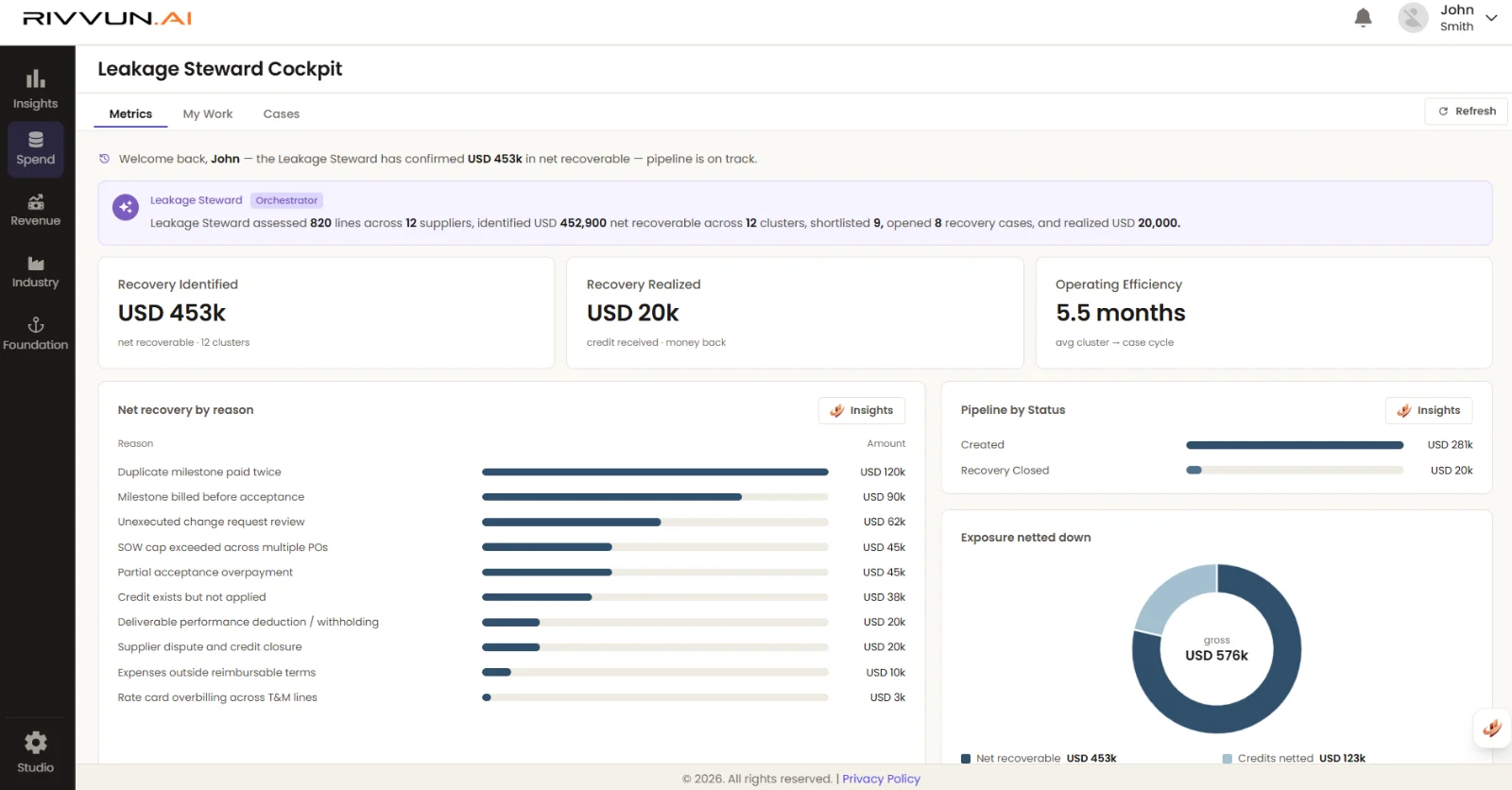
Every outcome is recorded against the transaction and contract term behind it.
- Gross signal versus net recoverable value
- Cash recovered, by supplier and cause
- Claims open, agreed and closed, with cycle time
- Recovered cash kept separate from savings and avoidance
- Recurrence rate after controls go live
Questions
What Is Supplier Overpayment Recovery?
Also called profit recovery, it identifies amounts paid beyond a supplier’s commercial entitlement, validates them against contracts and transaction evidence, and recovers the value through a credit, refund, repayment or offset.
What Is an AP Recovery Audit or Post-Payment Audit?
A review of paid invoices, payments, credits and supplier statements to find money already lost. Rivvun runs it continuously, and a finding becomes a claim only once the population, governing terms, calculation and counter-evidence are confirmed.
How Is This Different from a Contingency Recovery Audit?
A contingency audit is a one-off, backward-looking sweep paid as a share of recoveries, and it leaves root causes in place. Rivvun runs the same tests every payment cycle and turns each confirmed root cause into a forward control.
What Data Is Needed for a Recovery Scan?
Invoices, payments, credit memos, supplier statements, contracts and amendments, POs, receipts or service evidence, and supplier master data. Rivvun reconciles the population and identifies missing evidence before any case is claimed.
How Does Rivvun Calculate Net Recoverable Value?
It starts from the gross signal and subtracts existing credits, reversals, later amendments, supplier counter-evidence and exclusions. Recovery cost is reported separately, so finance sees gross and net recovery.
How Does Finance Validate Recovered Cash?
Finance confirms the credit, refund or offset was applied to the correct supplier balance and reconciles the ledger treatment. Recovered cash is kept separate from hard savings, cost avoidance and working-capital value.
How Is Recurrence Prevented?
The validated root cause becomes a forward control in Invoice Assurance, Contract Compliance or Direct Spend Assurance, and Rivvun monitors whether the exception recurs once the control is live.
Related Levers
- Invoice Assurance Rivvun checks every supplier invoice against contract price, quantity, fees and receipts before payment, so you pay exactly what you agreed. Learn More →
- Supplier Rebate Management Rivvun calculates supplier rebates from actual purchases as they happen, claims everything you’ve earned and gives finance accurate accruals. Learn More →
- Direct Spend Assurance Rivvun applies the pricing formula in every direct material contract, including index-linked prices and surcharges, to each invoice before payment. Learn More →
See What’s at Stake in Your Own Transactions.
A two-week value scan runs Rivvun on a sample of your data, with no integration, and sizes the revenue, margin and spend outcomes for your business.
-
Diagnose: Weeks 1-2
Value scan on your transactions. Value at stake sized by lever.
-
Deploy: Days 30-60
First agents live in your systems, first outcomes booked.
-
Scale: From There
More levers, entities and regions, reported monthly to finance.