Rivvun AI — System of Outcomes

Customer Invoice Assurance

Reconstruct the expected bil · Compare line by line · Fix it before issue
What this solution does

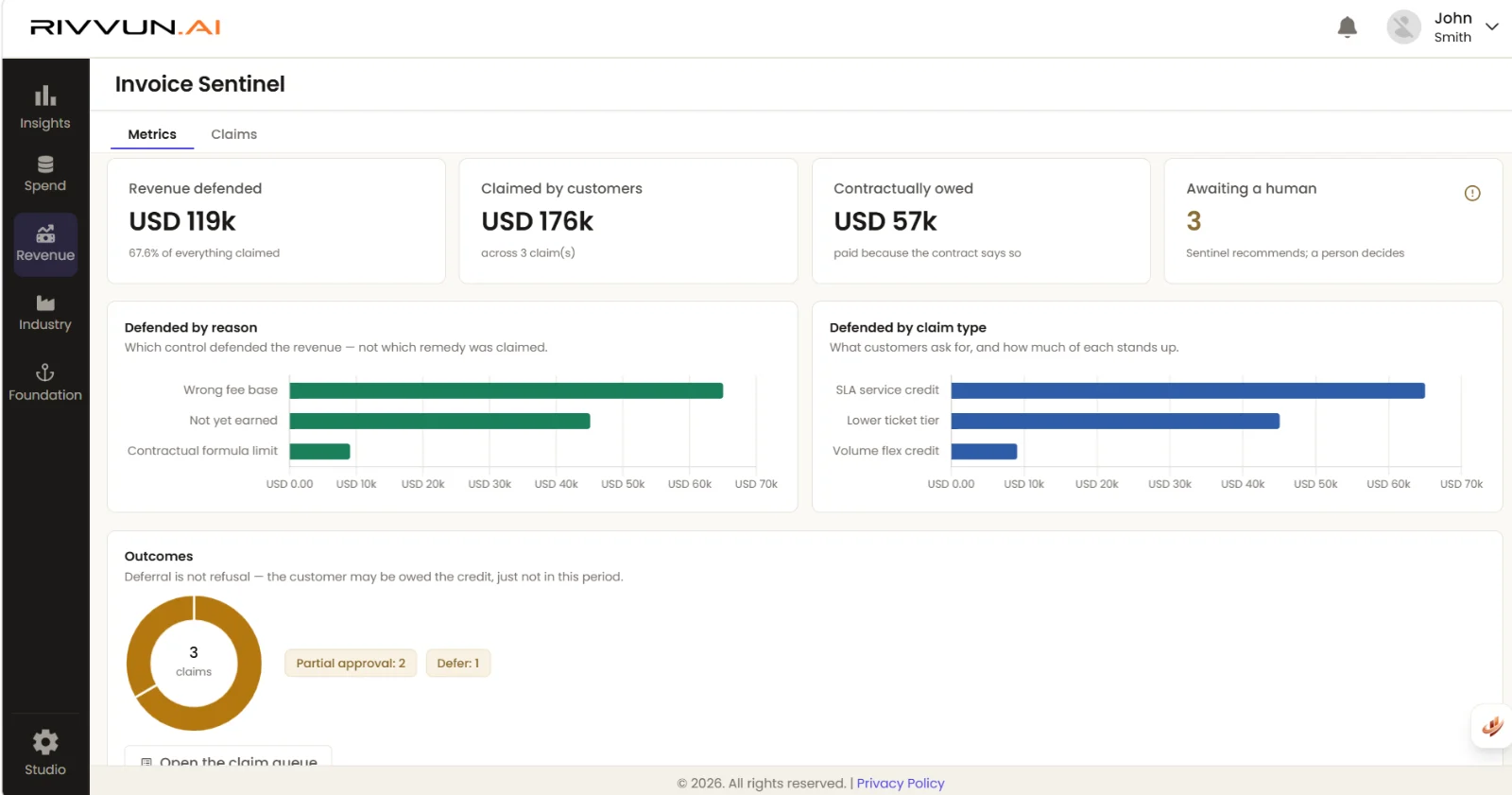
Rivvun’s Customer Invoice Assurance is agentic AI billing validation before invoice issue. AI Agent reconstructs the commercially expected bill line by line from the governing contract family, usage, delivery, acceptance, credit and prior-period evidence — clearing compliant lines within policy, capturing underbilling, and holding overbilling before it becomes credits, disputes and churn.

Why the value gap persists

Technically valid. Commercially wrong.

Why billing engines and revenue platforms still issue incorrect invoices.

The check that runs today

Billing proves arithmetic, not entitlement

The engine calculates flawlessly from configured products, rates and orders. But nothing tests whether the configuration reflects the governing agreement, the latest amendment, the delivery evidence or the permitted credits.

The result

Underbilling leaks, overbilling erodes trust

Omitted usage and fees leak revenue silently. Overbilled lines come back as credits, disputes, longer DSO and damaged customer trust — and every manual override bypasses another control.

The Rivvun standard

A billing engine proves a formula ran. Rivvun proves the customer was billed what the governing commercial truth permits.

Product experience

Four checks. One defensible invoice.

System of Outcomes
Detect → Recover → Prevent → Scale

Line-Level Assurance

Expected vs billed, every line

What you get

  • Every eligible invoice line reconstructed from the governing contract
  • Underbilling and overbilling shown as one variance, pre-issue
  • Related transactions checked together, not invoice by invoice
  • Confidence score on every decision
Revenue Sentinel · Invoice lines Line level
Line-Level Assurance

Commercial Validation

The contract in the room

What you get

  • Governing rate, tier, proration and credit rules applied per line
  • Amendment-aware — superseded schedules can't bill
  • Manual overrides and legacy credits re-authorized or retired
  • Source clause attached as evidence on every exception
Revenue Sentinel · Governing terms Entitlement
Commercial Validation

Operational Validation

Evidence before billing

What you get

  • Usage, delivery, milestones and acceptance verified at line level
  • Services bill only after the acceptance evidence exists
  • Missing evidence named, not just flagged
  • SLA credits computed from actual service performance
Revenue Sentinel · Evidence Operations
Operational Validation

Governed Execution

Clear, correct, hold — in policy

What you get

  • Compliant lines auto-clear inside confidence and value thresholds
  • Corrections written back to billing and ERP after approval
  • Every validated defect becomes a forward configuration control
  • Dispute and credit rates tracked to prove the trend
Revenue Sentinel · Decisions Execution
Governed Execution
Outcome

What billing and finance gain

First-pass accuracy is not a hygiene metric — it is revenue, DSO and customer trust decided before the invoice ships.

Controller & Billing Ops
  • Underbilling captured pre-issueOmitted usage, fees and adjustments caught while they are still billable in the current cycle.
  • Credits and disputes preventedOverbilled and unsupported lines held before they reach the customer, protecting trust and DSO.
RevOps & CFO
  • Revenue integrity across the estateIndependent assurance spanning CRM, CPQ, CLM, ERP and billing.
  • Root causes become controlsEvery validated defect turns into a configuration, master-data or contract fix that stops the recurrence.
Where this lands first

Where billing complexity concentrates

Evidence-heavy service billing and hybrid subscription models make these two US verticals the natural first proof.

Service vertical

Professional Services, IT & Managed Services

T&M, fixed-fee, milestone and managed-service invoices depend on SOW scope, rate cards, time, tickets, acceptance, caps and credits.

Priority plays
  • Rate card, role, hours and cap assurance
  • Milestone acceptance and change-order billing
  • SLA credits, expenses and approved pass-throughs
Product vertical

SaaS & Technology Products

Hybrid subscription, consumption and enterprise agreements create complex links among entitlements, usage, commitments, proration, credits and amendments.

Priority plays
  • Usage-to-entitlement-to-bill reconciliation
  • Minimum commitments, tiers, overages and true-ups
  • Proration, credits and amendment effective dates

Common questions

What is billing and customer invoice assurance?

It is contract-aware validation of customer invoices before or during issue. Revenue Sentinel reconstructs the commercially expected bill at line level from the governing contract, usage, delivery, acceptance and credit evidence, then clears, corrects or holds each line under policy.

How is this different from our billing engine's validation?

Billing engines validate against their own configuration. Rivvun validates the configuration itself — independently reconstructing what the governing contract and operational evidence permit, across mixed CRM, CPQ, CLM, ERP and billing estates.

Does this catch underbilling or just overbilling?

Both, deliberately. Underbilling is captured while it is still billable in the current cycle; overbilling and unsupported charges are held before they become credits, disputes and DSO. The same expected-versus-billed logic drives both.

Is this the same as revenue assurance in telecom?

It generalizes that discipline. Telecom revenue assurance reconciles usage to billing inside one estate. Rivvun adds cross-industry B2B contract authority — amendments, rate cards, SLAs, credits — and governed correction across heterogeneous systems.

What data does it need?

Read-only access to contracts and amendments, quotes and orders, usage or service evidence, draft or issued invoices, credits and payment history. The Revenue Commercial Data Foundation binds them into one governed evidence model.

Can the agent hold an invoice on its own?

Only within policy. Compliant lines clear inside configured confidence and value thresholds. Holding a material line, issuing a correction or contacting a customer requires accountable human approval with segregation of duties.

How is value measured?

Invoice-line assurance coverage, underbilling captured, overbilling prevented, first-pass billing accuracy, exception rate, dispute and credit rate, and bill-to-cash cycle time — tracked as evidence-gated states in the Revenue Value Ledger.

How do we start?

With a Billing Integrity Scan on one high-value invoice cohort — amendments, usage or service evidence, credits and manual adjustments included. You get quantified underbilling, overbilling and evidence gaps, line by line.

Start here

Bill what the contract permits. Every line. Every cycle.

Give us one invoice cohort and the contracts behind it. We return expected-versus-billed on every line, the exceptions that matter and the controls that stop the recurrence.

Start a Billing Integrity Scan