
How Rivvun Delivers It
The System of Outcomes
-
01
Detect
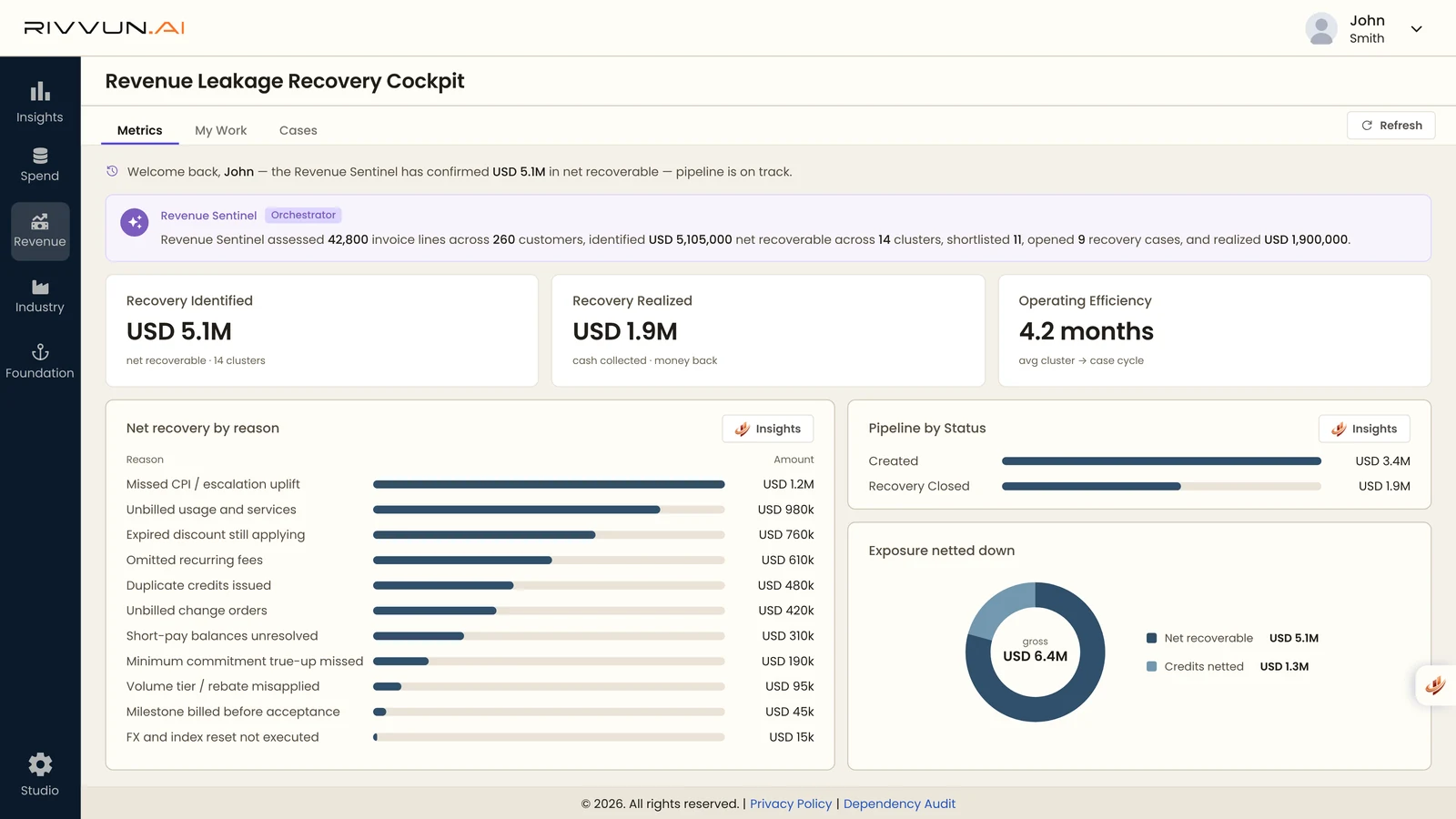
Revenue Sentinel scans 12 to 24 months of contracts, billing and cash for missed escalations, unbilled usage, expired discounts, duplicate credits and short-pay.
-
02
Enforce
Billing terms are applied to past periods as well as current ones. Related customers, products and periods become one evidence-backed case, and the route is chosen deliberately (back-bill, staged recovery, renewal capture or write-off) and approved before anything reaches a customer.
-
03
Prevent
Cash is reconciled to invoice, credit and payment before a case closes, and each root cause is armed as a billing or entitlement control.
-
04
Scale
Recovery runs continuously across the customer base, with recurrence tracked per pattern so the same gap stays closed.
What Finance Sees
Every outcome is recorded against the transaction and contract term behind it.
- Gross signal versus validated net recoverable value
- Billed and collected recovery
- Case conversion rate and cycle time
- Unbilled revenue at period end
- Recurrence rate after controls go live
Questions
What Is Revenue Leakage Recovery?
Recovering earned-but-unbilled and under-collected revenue, validated against the governing contract, executed as governed customer cases and reconciled to cash.
How Is This Different from a Revenue Recovery Audit?
An audit is a periodic sample that ends with a report. Rivvun runs continuously, validates entitlement before any claim, verifies cash and turns each root cause into a forward control.
How Much Revenue Do Companies Typically Leak?
Public estimates put it at roughly 3 to 5% of revenue (MGI Research) and 1 to 5% of EBITDA (EY). Your own number comes from a bounded scan of your contract and billing history.
Will Recovery Damage Customer Relationships?
Every case carries relationship guardrails and materiality thresholds, with options from immediate invoicing to capture at renewal. Nothing reaches a customer without accountable approval.
How Far Back Can Rivvun Recover?
Typically 12 to 24 months, bounded by contractual back-billing limits, limitation periods and your policy.
How Is Recovered Value Measured?
Gross signal, validated net recoverable value, billed and collected recovery, cycle time and recurrence rate, evidence-gated so nothing is double counted.
Related Levers
- Billing & Invoice Assurance Rivvun checks every outgoing invoice against the customer contract before it’s sent, cutting disputes, credits and days sales outstanding. Learn More →
- Commercial Entitlement & Escalation Rivvun tracks every CPI, index-linked and fixed price escalation in your customer contracts and applies it on the day it’s due. Learn More →
- Trade Promotion & Settlement Assurance Rivvun validates every trade claim and deduction against the governing agreement, proof of performance and every settlement route before it clears. Learn More →
See What’s at Stake in Your Own Transactions.
A two-week value scan runs Rivvun on a sample of your data, with no integration, and sizes the revenue, margin and spend outcomes for your business.
-
Diagnose: Weeks 1-2
Value scan on your transactions. Value at stake sized by lever.
-
Deploy: Days 30-60
First agents live in your systems, first outcomes booked.
-
Scale: From There
More levers, entities and regions, reported monthly to finance.