
How Rivvun Delivers It
The System of Outcomes
-
01
Detect
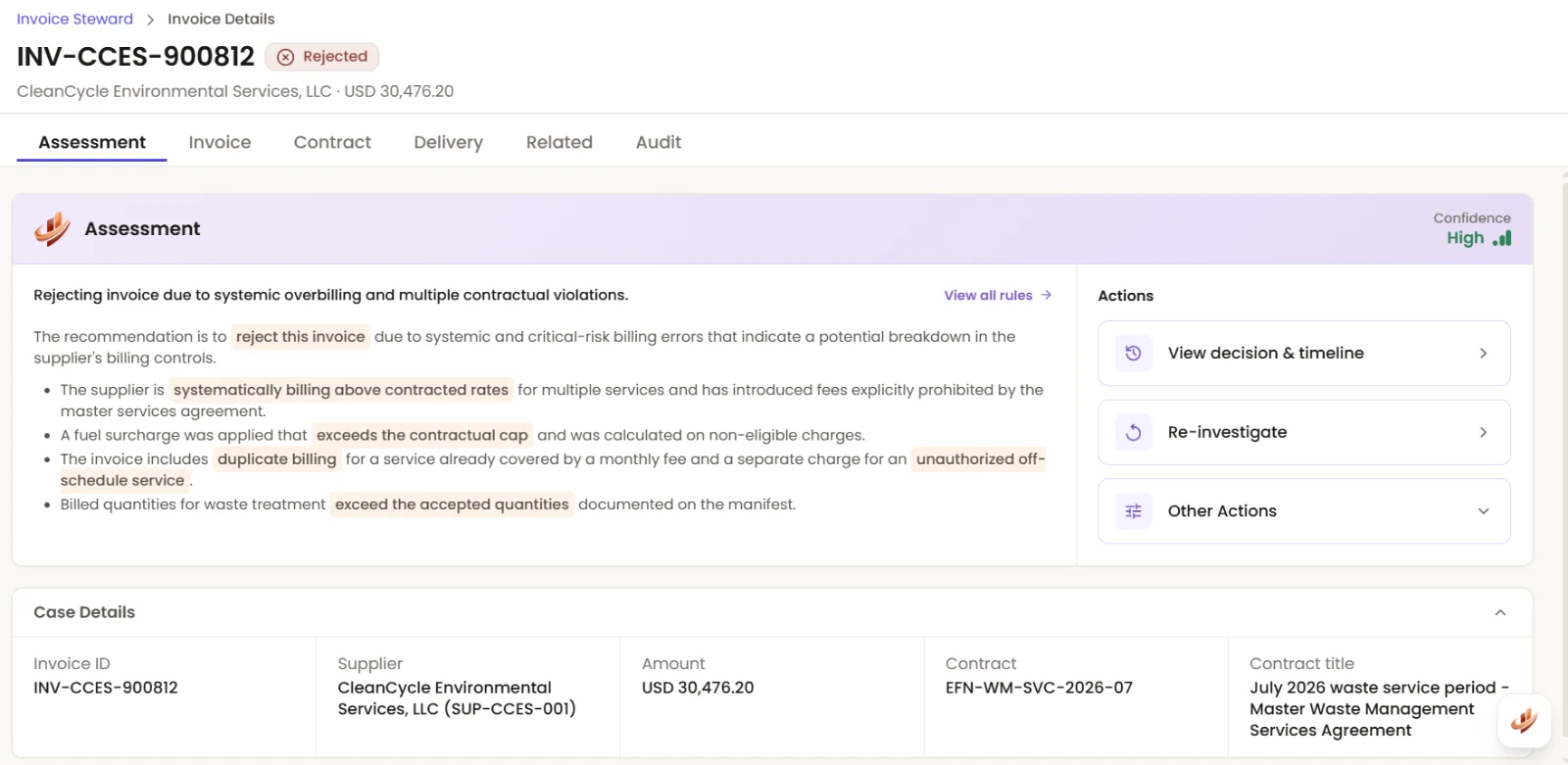
Invoice Steward tests every invoice line against the contract, rate card, cap, credit and delivery evidence, scoring expected versus billed.
-
02
Enforce
Every invoice line is checked against the contract before payment. Lines that break the terms are held and resolved with the supplier, with the clause and evidence attached; lines already paid in error move to Supplier Overpayment Recovery.
-
03
Prevent
Each confirmed root cause becomes a pre-payment control: price records corrected, amendments applied, missing acceptance or delivery evidence named.
-
04
Scale
Compliant lines clear automatically within policy; the same checks run across every supplier, entity and invoice format, with human approval on consequential actions.
What Finance Sees
Every outcome is recorded against the transaction and contract term behind it.
- Spend avoided before payment, by supplier and cause
- Invoice lines tested as a share of eligible spend
- First-pass match rate and exception rate
- Identified, validated, prevented and recovered value, kept separate
- Time from invoice receipt to decision
Questions
What Is Invoice Assurance?
Rivvun’s agentic AI invoice audit: contract-aware validation of supplier invoices before or during payment approval. Invoice Steward tests each charge against the governing contract, rate card, cap, milestone, credit, fee rule and delivery evidence to decide whether the line is commercially payable.
Isn’t This What Three-Way Match Already Does?
No. Match compares invoice, PO and receipt, and none of those documents carries the contracted rate, the cap, the credit or the service level. The match can pass while the charge breaches the contract.
How Is Rivvun Different from AP Automation or Anomaly Detection?
AP automation moves the invoice faster; anomaly detection flags statistical outliers. Neither can say whether a charge is contractually payable. Rivvun answers that line by line and states the action: clear, hold or route.
Is This a Pre-Payment Invoice Audit?
Yes. Invoice Assurance applies audit-grade commercial checks before payment where the evidence exists. Historical paid transactions are handled by Supplier Overpayment Recovery.
How Are Services and Non-PO Invoices Assessed?
Rivvun links the invoice to the SOW, rate card, milestone, timesheet, acceptance record or other evidence. Where evidence is incomplete, the line is routed with the missing evidence named rather than approved or rejected automatically.
Can the Agents Hold or Pay on Their Own?
Only within policy. Compliant lines clear inside configured thresholds. Every consequential action, such as holding a payment or contacting a supplier, requires human approval, with segregation of duties enforced.
How Are Savings Measured?
Identified variance, validated variance, prevented value, recovered value and realized hard savings are recorded separately. Prevented value requires evidence the amount was not paid; recovered value requires a received credit, refund or offset.
Related Levers
- Supplier Overpayment Recovery Find and recover duplicate payments, missed credits and prices paid above contract, then stop the same overpayment happening again. Learn More →
- Supplier Rebate Management Rivvun calculates supplier rebates from actual purchases as they happen, claims everything you’ve earned and gives finance accurate accruals. Learn More →
- Direct Spend Assurance Rivvun applies the pricing formula in every direct material contract, including index-linked prices and surcharges, to each invoice before payment. Learn More →
See What’s at Stake in Your Own Transactions.
A two-week value scan runs Rivvun on a sample of your data, with no integration, and sizes the revenue, margin and spend outcomes for your business.
-
Diagnose: Weeks 1-2
Value scan on your transactions. Value at stake sized by lever.
-
Deploy: Days 30-60
First agents live in your systems, first outcomes booked.
-
Scale: From There
More levers, entities and regions, reported monthly to finance.