
How Rivvun Delivers It
The System of Outcomes
-
01
Detect
Category playbooks reconcile eligible spend by category, supplier, entity and region, then test plays for consolidation, harmonization, demand aggregation and tier capture.
-
02
Enforce
One evidence standard is enforced before any opportunity reaches a decision. Each is tested against the evidence that could disprove it, then presented with a baseline, a like-for-like comparison and a recommended action.
-
03
Prevent
Approved actions are linked to the sourcing, contract, price-file or PO change that implements them, and benefit erosion is monitored afterwards.
-
04
Scale
Opportunities refresh as new spend arrives across all categories and markets, giving category managers a ranked pipeline before each sourcing cycle.
What Finance Sees
Every outcome is recorded against the transaction and contract term behind it.
- Identified, validated and finance-accepted savings
- Savings executed this quarter versus in the sourcing pipeline
- Hard savings, avoidance and working capital, reported separately
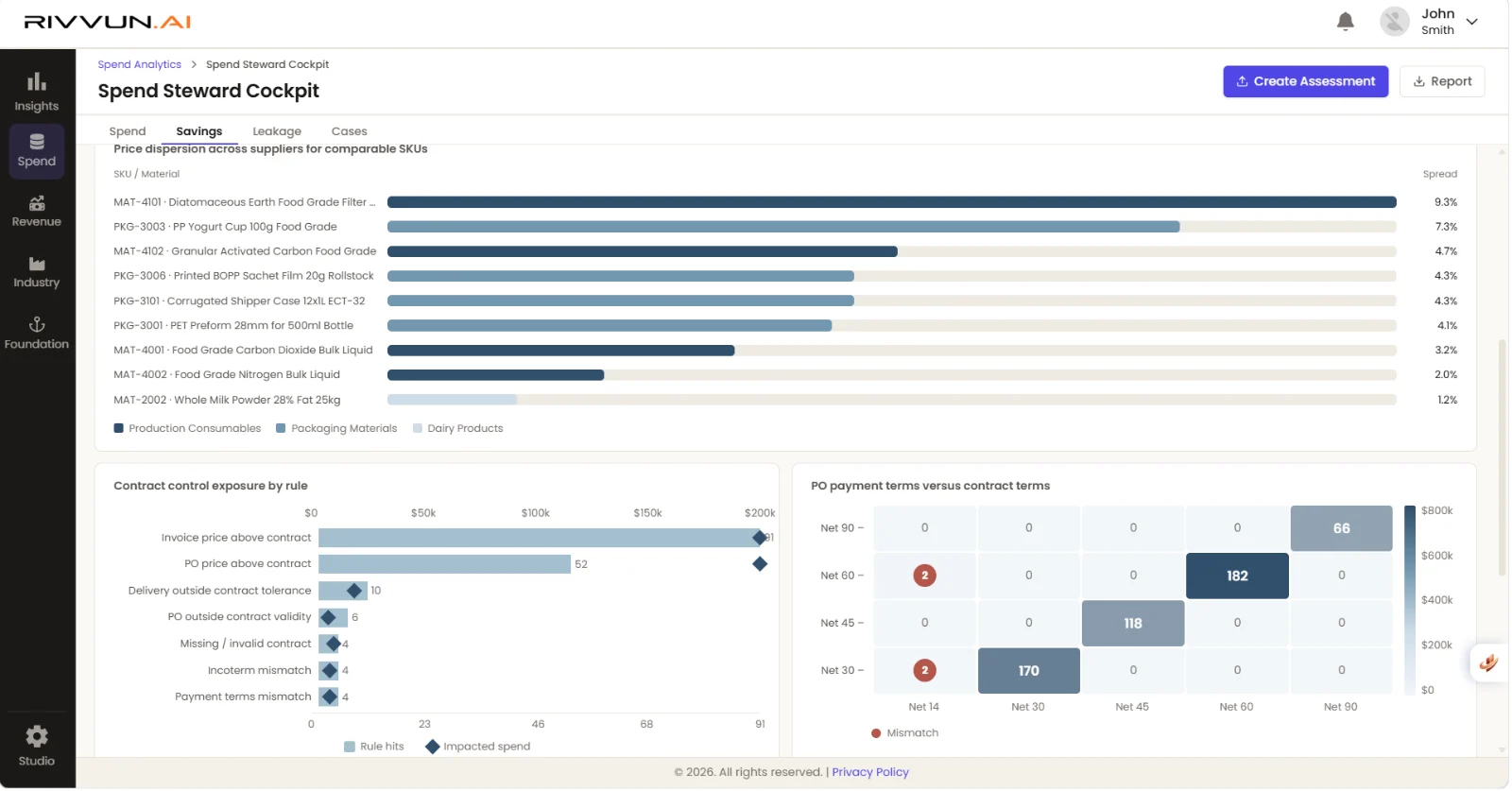
- Supplier count and price dispersion by category
- Benefit erosion after implementation
Questions
What Is Spend Optimization?
Rivvun’s agentic AI approach to cost reduction: category playbooks applied to connected spend and contract evidence, qualified opportunities turned into owned actions, and savings verified in invoices and the P&L without double counting.
How Are Opportunities Qualified?
Each signal is tested against counter-evidence, addressable spend, confidence, feasibility, time to value, supplier dependency and implementation risk. Unsupported signals are rejected or routed for remediation.
How Is Rivvun Different from Spend Analytics?
Analytics stops at a ranked list. Rivvun routes each opportunity into an owned case with a baseline, evidence and accountable approvers, creating a governed savings pipeline.
How Are Realized Savings Verified?
Implementation is confirmed in the system of record and subsequent PO, invoice, credit, payment or usage evidence is validated before value moves to finance accepted.
How Does Rivvun Prevent Double Counting?
Potential, qualified, approved, committed, implemented and finance-accepted value stay separate, and hard savings, recovery, avoidance and working capital are reported independently.
Related Levers
- Invoice Assurance Rivvun checks every supplier invoice against contract price, quantity, fees and receipts before payment, so you pay exactly what you agreed. Learn More →
- Supplier Overpayment Recovery Find and recover duplicate payments, missed credits and prices paid above contract, then stop the same overpayment happening again. Learn More →
- Supplier Rebate Management Rivvun calculates supplier rebates from actual purchases as they happen, claims everything you’ve earned and gives finance accurate accruals. Learn More →
See What’s at Stake in Your Own Transactions.
A two-week value scan runs Rivvun on a sample of your data, with no integration, and sizes the revenue, margin and spend outcomes for your business.
-
Diagnose: Weeks 1-2
Value scan on your transactions. Value at stake sized by lever.
-
Deploy: Days 30-60
First agents live in your systems, first outcomes booked.
-
Scale: From There
More levers, entities and regions, reported monthly to finance.