

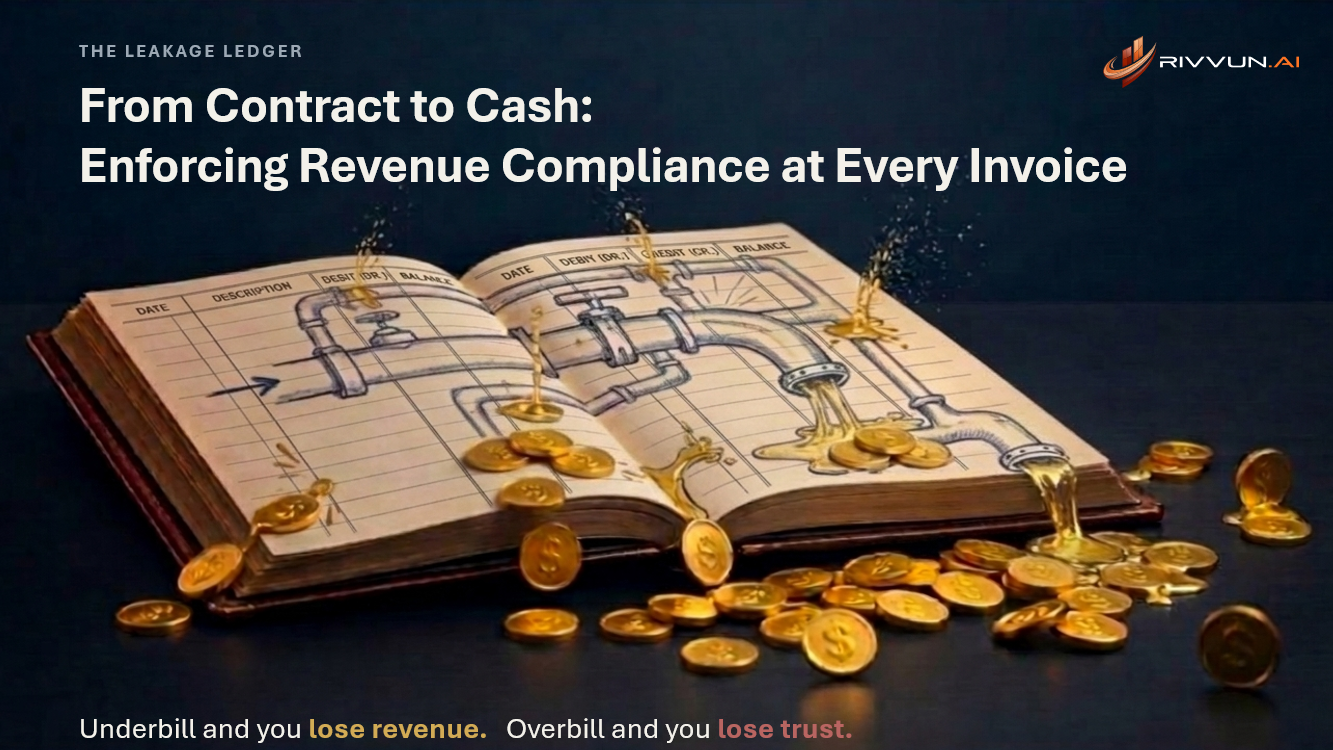
Your contract governs every invoice. So why are people still checking every line?
For finance and revenue leaders, billing accuracy no longer depends on any single system. It depends on whether five or six systems agree with each other, and with the contract that is supposed to govern them all.
That has become harder as commercial models have evolved. Contracts increasingly price on usage, volume tiers and minimum commitments. They carry service-level guarantees with credit provisions attached. And they change constantly, as customers expand, add products, scale back and renew. Every one of those terms has to land correctly on an invoice, every billing cycle.
Knowing what the contract says is only the first step. Teams also have to confirm that the quote, the billing record, the operational data and the revenue books all reflect it, across hundreds or thousands of customer relationships, without relying on armies of people to check line by line.
Where the gap leaks
Every system does its job. None of them reads the contract.
A single customer transaction rarely lives in one place. It begins in one system, gets priced and approved in another, is captured in a contract stored somewhere else, moves through operational systems for fulfillment and invoicing, and eventually shows up in the ERP as revenue and margin.
- CRMthe deal
- CPQthe order form
- CLMsigned Contracts PDFs
- Billingthe invoice
- ERPrevenue books
Every handoff reconciled by hand: re-keying and line-by-line checks
The contract governs every step, yet it is the one link that often exists only as unstructured text.
A customer relationship is never a single document. It is a master agreement, a series of order forms, and a growing trail of amendments as the account changes over time. Together, those documents define what every invoice should say: which products, at what price, under which tiers, with which credits and commitments.
The contract is the governing authority for every commercial transaction. Because it lives as text rather than data, the work of reconciling it against everything downstream falls to people. We have written before about why systems of record and intelligence stop short of the outcome. On the sell side, that gap shows up in the invoice.
From a recent customer pilot
On paper the process is automated. In practice, the revenue engine is people.
In a recent working session with the finance and billing leadership of a global software company, the scale of that manual effort came into sharp focus.
The company runs a modern, well-regarded stack: a leading CRM, a dedicated quoting platform, a standalone billing system, an ERP for revenue accounting, and a document repository holding all its executed contracts and order forms.
Yet the billing leader described the company’s true system as a team of dozens of people from different departments who every month validate every invoice line against the contract and monthly operational data by hand, then enter it into the billing system.
What the stack handles well
- Managing accounts and pipeline
- Building quotes and order forms
- Storing executed contracts
- Generating and sending invoices
- Recognizing revenue
What falls to people
- Checking invoice lines against contract terms
- Applying tiers, minimums and overages
- Pushing amendments into billing
- Evaluating credit claims against SLAs
- Reconciling one system against the next
This is not a story about a team doing something wrong. It is what happens when commercial complexity outgrows the connections between systems. The people become the integration layer. They absorb every mismatch, every amendment and every exception. And manual work carries manual limits: it is slow, it is expensive, it does not scale with the business, and some errors inevitably get through.
Where sell-side value leaks
Underbill and you lose revenue. Overbill and you lose trust.
On the sell side, leakage runs in both directions. Underbilling means revenue that was earned is never collected. Overbilling brings its own costs: credits issued, invoices disputed, collections delayed, and customers who trust the next invoice a little less. Three patterns account for much of the exposure.
Pricing that depends on operational data
The rate card is in the order form, but the volume sits in an operational system. When the two are joined by hand, tiers are missed, minimums go unenforced and overages go unbilled.
Credit claims and SLA commitments
When a customer claims a credit for downtime, the answer is in clause-level detail. Without it, teams either over-credit to protect the relationship or push back without evidence.
Contracts that keep changing
Products are added and removed, discounts renegotiated, uplifts applied at renewal. When amendments do not reach billing, invoices describe an agreement that no longer exists.
The Renewal That Looked Right
The renewal was closed. The revenue was wrong. A customer renewed for another year. The CRM showed a successful renewal, the contract was signed, and everyone moved on. But buried in the contract was an agreed price increase. That increase never made it into billing, and an old discount carried forward as well. Nothing was obviously broken. Each system looked right on its own. Rivvun Agents connected the renewal, contract, pricing terms, and invoices and surfaced what had been missed: the customer was being billed below the economics everyone had agreed to. A successful renewal had quietly become a recurring revenue leak.
The Invoice the Customer Refused to Pay
The customer said they were owed a credit. The contract said: not so fast. A customer withheld payment on an invoice, citing an SLA breach and requesting a substantial service credit. The dispute landed with finance as another unresolved receivable. Rivvun Agents went beyond the claim. They traced the customer’s allegation back to the contract, the specific SLA thresholds, actual service performance, and the credit provisions governing the agreement. The result was a very different picture: the customer had a legitimate claim, but not necessarily for the amount being withheld. What looked like a collections problem became a contract-evidence problem. Rivvun Agents gave finance a defensible view of what was actually owed, what credit was warranted, and where the customer’s claim exceeded the agreement.
The control point
An audit looks back. The better check happens before the invoice.
An audit happens at quarter end or year end, after invoices have been issued, after customers have disputed them, and after someone has spent days reconstructing what the contract required. By then, the cost of the error has already been paid, in revenue, in effort or in the customer relationship.
The more valuable control point is earlier. When the contract, the CRM record, the billing data and the operational metrics are reconciled before an invoice is submitted, the invoice is right the first time. When a credit claim arrives, it can be evaluated against the governing clause and the supporting evidence immediately, rather than negotiated over weeks.
The checking is periodic. The billing is continuous. The reconciliation has to be continuous too.
What we are building at Rivvun
An agent layer across the systems you already run. No rip-and-replace.
The work these billing teams perform is high-volume, rules-driven cross-checking across documents and systems. It means reading contract language, understanding how terms interact, and comparing them against transactional and operational data. It is exactly the kind of work AI agents can now perform consistently and at scale, with people reviewing the exceptions rather than every line.
A contract data foundation
Agreements, order forms and amendments are digitized and linked to accounts, products, pricing, tiers, SLAs and credit terms. Clause language becomes computable rules.
Agents that reconcile continuously
The Revenue Sentinel checks invoices before they go out and assesses credit claims against the governing terms. The Renewal Sentinel assembles contract, billing and usage history for renewals.
Evidence behind every decision
Each assessment shows which terms applied, which data was used, what passed, what failed and why, so finance can verify a conclusion before acting on it.
Works with your current stack
Agents connect to the CRM, billing, ERP and document systems already in place, using real-time feeds, a data lake or published reports.
What finance leaders are asking for
Nobody asked to replace a system. They asked for the systems to agree.
“Today, reconciling what was sold, what was contracted, what was billed, and what ultimately hits the books requires manually piecing together data across multiple systems. Automating that process would help us catch revenue leakage, improve financial accuracy, and close the books faster, with greater confidence in our numbers.”
VP Finance, Global SaaS Technology Provider
Every platform in that stack is staying. The need is for a layer that works across them, with the contract as the authority that settles disagreements.
Turning contracts into revenue certainty
The goal is not a better audit. It is an invoice that is right the first time.
Revenue accuracy depends on whether what was agreed in the contract is carried faithfully through every downstream system, and whether teams can verify that before money changes hands. For businesses managing thousands of evolving customer relationships, manual reconciliation makes that verification slow, costly and incomplete.
Do your teams know what the contracts say?
Can they find a mismatch at quarter end?
Can they confirm every invoice matches the contract before it goes out?
By connecting contract intelligence to billing, operational and financial data, and acting on it before invoices are issued, finance leaders can move from discovering leakage after the fact to preventing it at the source.
From people checking every line. To contracts that check themselves.
The Leakage Ledger is Rivvun’s series on where contract value slips away after signature, and what enterprises can do about it.