

Finance teams have never had more systems, or less certainty about where their margin goes. Tariffs, commodity swings and layered rebate terms now change the economics of a deal after it is signed, which is why I believe the next step for finance is a system of outcomes: one that checks every transaction against what was agreed before money moves.
Deere & Co. shows how tight the math has become. It expects to raise prices this year and to pay about $1.2 billion in tariffs. When it gave its outlook in February, it said the two would roughly cancel out. A year of price increases buys something close to a standstill.
Tariffs at least show up where everyone can see them. The losses that worry me more don’t. Try this: ask your procurement team for last year’s negotiated savings, then ask your controller to find them in cost of goods sold. In most companies the second number is smaller, and nobody can account for the whole difference.
That difference rarely gets a line of its own. It hides in purchase price variance, in the deductions reserve, in rebate accruals trued up at quarter end and in the “other” bucket within cost of goods. Each piece gets explained away as timing or mix. Add them up and you find surcharges the contract never allowed, rebates nobody claimed, price increases that never reached the invoice and retailer claims paid without proof, repeated across tens of thousands of transactions a month.
What companies are disclosing
The Numbers Are Already in the Filings
This year companies started putting numbers on the mechanisms behind their margins.
| Company | What was disclosed in 2026 |
|---|---|
| Caterpillar | About $2.2B of 2026 tariff costs; $392M of expected tariff refunds booked in Q2 |
| Novo Nordisk | US sales to fall in the teens on a shift to self-pay and rising insurer rebate demands |
| Procter & Gamble | Promotion levels returning to pre-COVID norms; fiscal 2026 core gross margin down 40 bps |
| Nestlé | H1 gross margin down 20 bps; CHF 600M of procurement and operating savings |
| Mondelez | Gross margin 28.4% in 2025 vs. 39.1% in 2024; 2026 cocoa locked in before prices fell |
| Stanley Black & Decker | Net tariff refunds added about 250 bps to Q2 gross margin |
Sources: SEC filings, company results and earnings calls, and news reports. Full links below. Compiled by Rivvun, October 2026.
Very little on this list was decided at the negotiating table. Promotions, insurer rebates, surcharges and refunds are all settled afterward. Caterpillar and Stanley Black & Decker are collecting refunds on tariffs the Supreme Court struck down in February, and every importer has to file, track and reconcile those claims itself. Money owed back is the easiest kind to leave behind.
Why it persists
Every System Does Its Job. None of Them Owns the Outcome.
Procurement suites know what was ordered, contract systems know what was agreed and the ERP knows what was invoiced. Nothing checks the three against each other before money moves, so a three-way match will pass an invoice that agrees with the purchase order even when both disagree with the contract.
The purchase order matches the invoice. Both disagree with the contract.
I saw this at a satellite communications company that had just closed an acquisition and folded two supplier bases into one. The systems on both sides worked, yet nobody could say with confidence what the combined company was supposed to be paying each supplier. It took 14 weeks to build a single, current view of those terms. Once it existed, $70 million in savings was in plain sight.
The revenue side leaks the same way, only more quietly. A contracted price uplift never gets loaded into billing. A customer falls short of its volume commitment, and the shortfall fee written into the contract is never invoiced. A change order expands the scope of work, and nobody bills for the extra. None of it shows up as a loss. Revenue that was never billed is never recognized, so it simply isn’t there to miss.
The organization chart has the same seam. Procurement is measured at signing, sales at quote and payables on speed. Each team hits its number, and the CFO inherits the gap a quarter later as a variance.
The size of it
Savings Shouldn’t Count Until They Show up in COGS.
Take a $5 billion company with $2 billion of addressable outside spend. If 3% of that spend and 1% of revenue drift from agreed terms, the low end of what we see, $110 million a year never arrives. At the high end it is $360 million. The spend range comes from McKinsey research and the revenue range from our own work.
Kraft Heinz has guided its adjusted gross margin down 10 to 50 basis points this year, and analysts will argue over every one of them. A $110 million gap at a $5 billion company is 220 basis points that never reaches an earnings slide.
Part of the reason is an asymmetry most finance teams accept without noticing. Revenue is recognized only when it is earned, and auditors test it. Savings are usually self-reported at signature and never tested again. I have spent much of my career alongside procurement teams, and I still think the standard should be the same for both. A saving counts when it shows up in cost of goods sold, not before.
Why the fixes fall short
The Usual Fixes Arrive After the Money Has Moved.
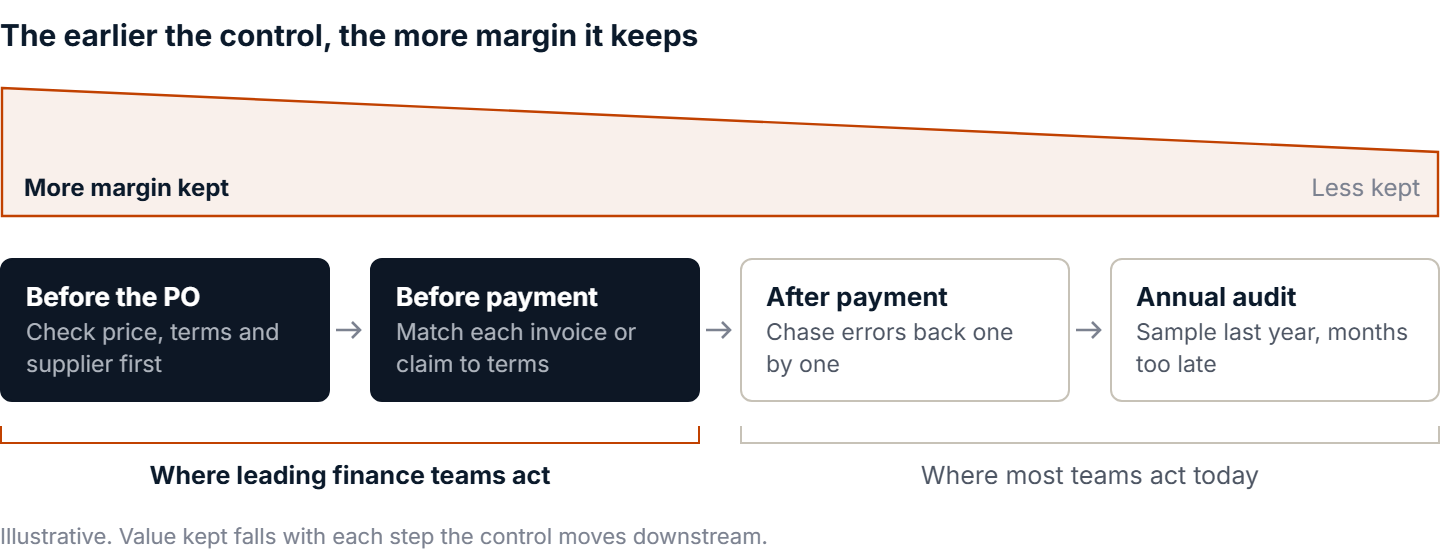
Recovery audits find real cash, but months later and only what the documents can prove, and the next invoice goes through unchanged. ERP programs take years while tariff schedules change by the quarter. Adding people helps until the exceptions outrun hiring. The cheapest moment to stop an error is before the purchase order is released or the payment goes out.
AI hasn’t changed that yet. MIT researchers reported last year that about 95% of the enterprise generative-AI pilots they studied delivered little or no measurable impact on profit and loss. Most pilots stop at a recommendation someone still has to act on. In finance, the AI worth funding is the kind whose output is an entry in the ledger.
Before your next close
Five Questions Worth Asking This Week.
- What are our current terms with each top supplier and customer, after every amendment?
- How many supplier invoices carried a surcharge last quarter, and how many did we check against the contract?
- Which rebates, credits and tariff refunds are we owed but haven’t received?
- Which customer deductions and chargebacks did we pay without validating them?
- How much of this year’s reported savings can we trace into cost of goods sold?
If the honest answers start with “we’d have to look,” the gap is real. Deere can put a number on its tariff bill. Very few companies can put one on the terms they agreed to and never collected. Until they can, the rule holds: if it’s not in EBITDA, it didn’t happen.
Anand Veerkar is co-founder and chief executive of Rivvun AI, whose agents check purchase orders, invoices, claims and credits against agreed terms before money moves.
Sources and Attribution
Deere Q1 fiscal 2026 earnings call, The Motley Fool via AOL
Caterpillar Form 10-Q, Q2 2026, SEC
Novo Nordisk 2026 guidance, Reuters via BNN Bloomberg
P&G Q4 FY2026 earnings call highlights, GuruFocus
Nestlé half-year results 2026
Mondelez 2025 results, FoodIngredientsFirst
Mondelez on 2026 cocoa costs, Supermarket Perimeter
Stanley Black & Decker Q2 2026 results, Form 8-K, SEC
Stanley Black & Decker Form 10-Q on the IEEPA ruling, SEC
Kraft Heinz Q2 2026 outlook, Form 8-K, SEC
MIT NANDA, The GenAI Divide, Fortune