What is AI spend classification?
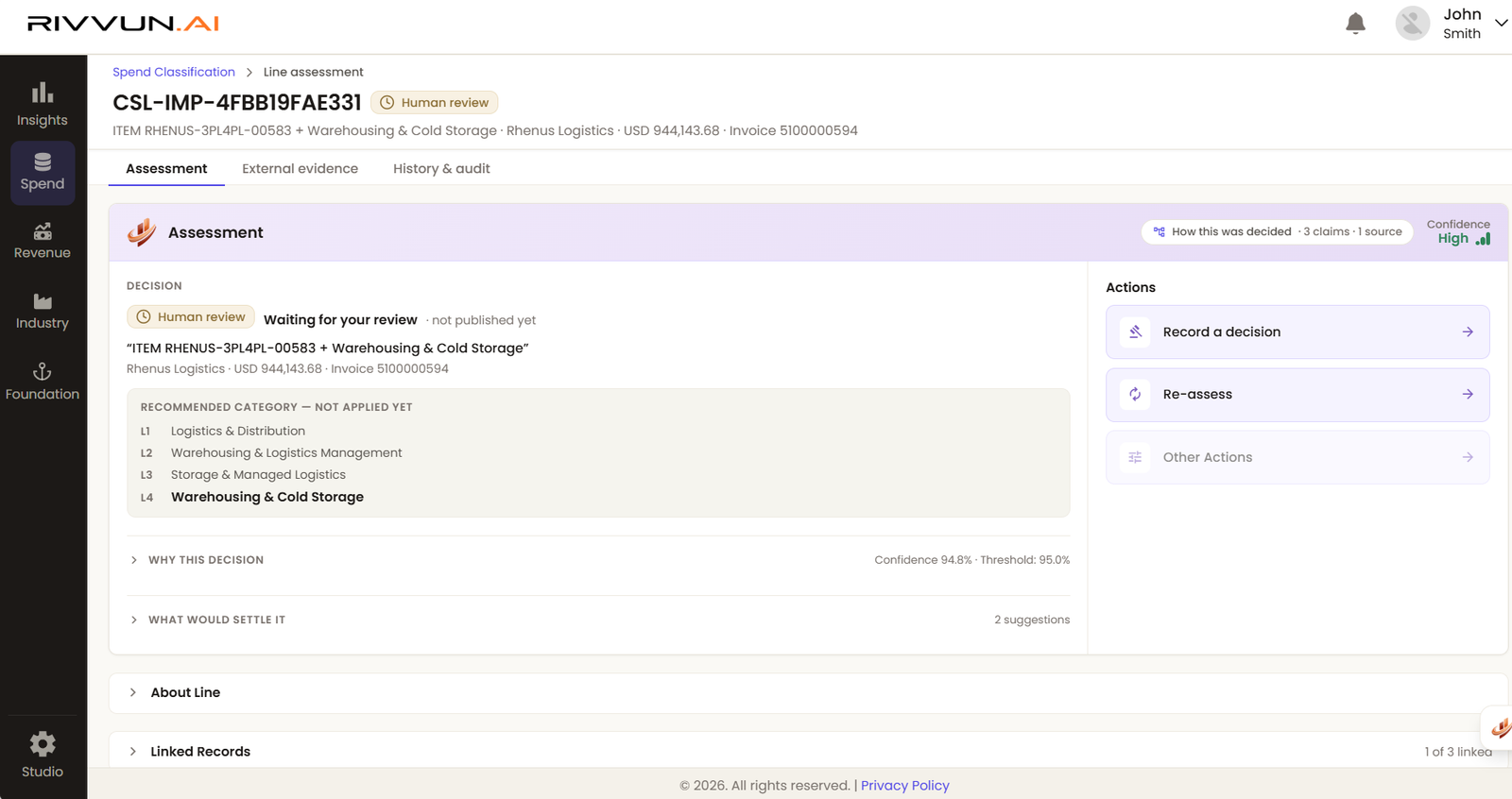
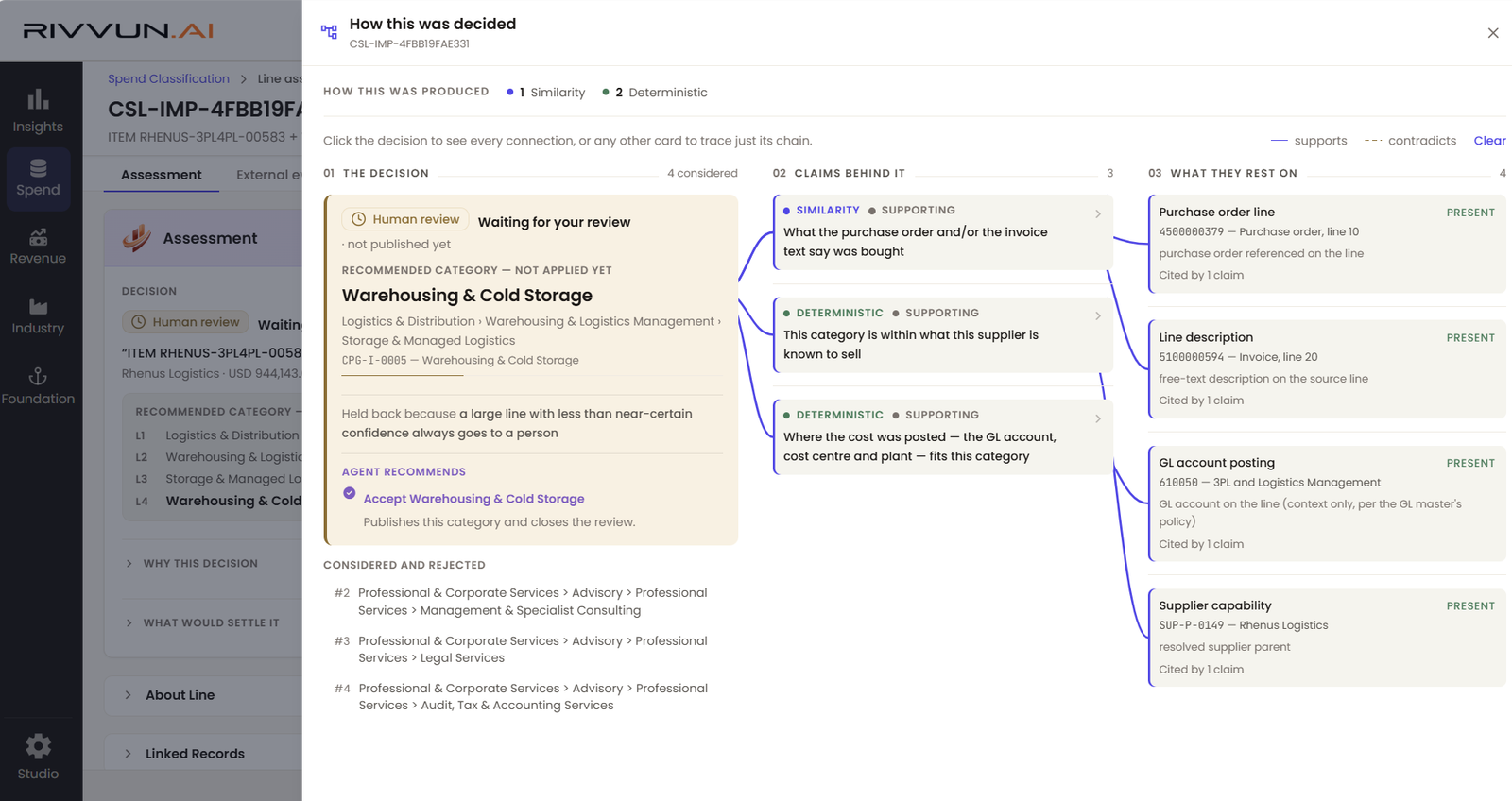
AI spend classification determines what was actually purchased on each transaction line and assigns it to a procurement category. Rivvun runs it as a governed process: linked enterprise evidence selects the deepest category that evidence can defend, and every decision is published with its rationale, candidates, confidence and version.
What is line-level spend classification, and why does it matter?
Line-level classification categorizes each invoice or PO line rather than the supplier or the GL account. It matters because a diversified supplier sells across many categories — classify at supplier level and packaging, ingredients and MRO all collapse into one bucket, which makes price comparison and demand aggregation impossible.
How is Rivvun different from supplier-based spend classification?
Supplier identity is context, not the answer. Rivvun uses item and service master, contract, catalog, SOW, PO and invoice semantics, accounting, plant and product evidence, so diversified suppliers and marketplaces do not force every line into one broad category.
Can Rivvun classify poor-quality spend data?
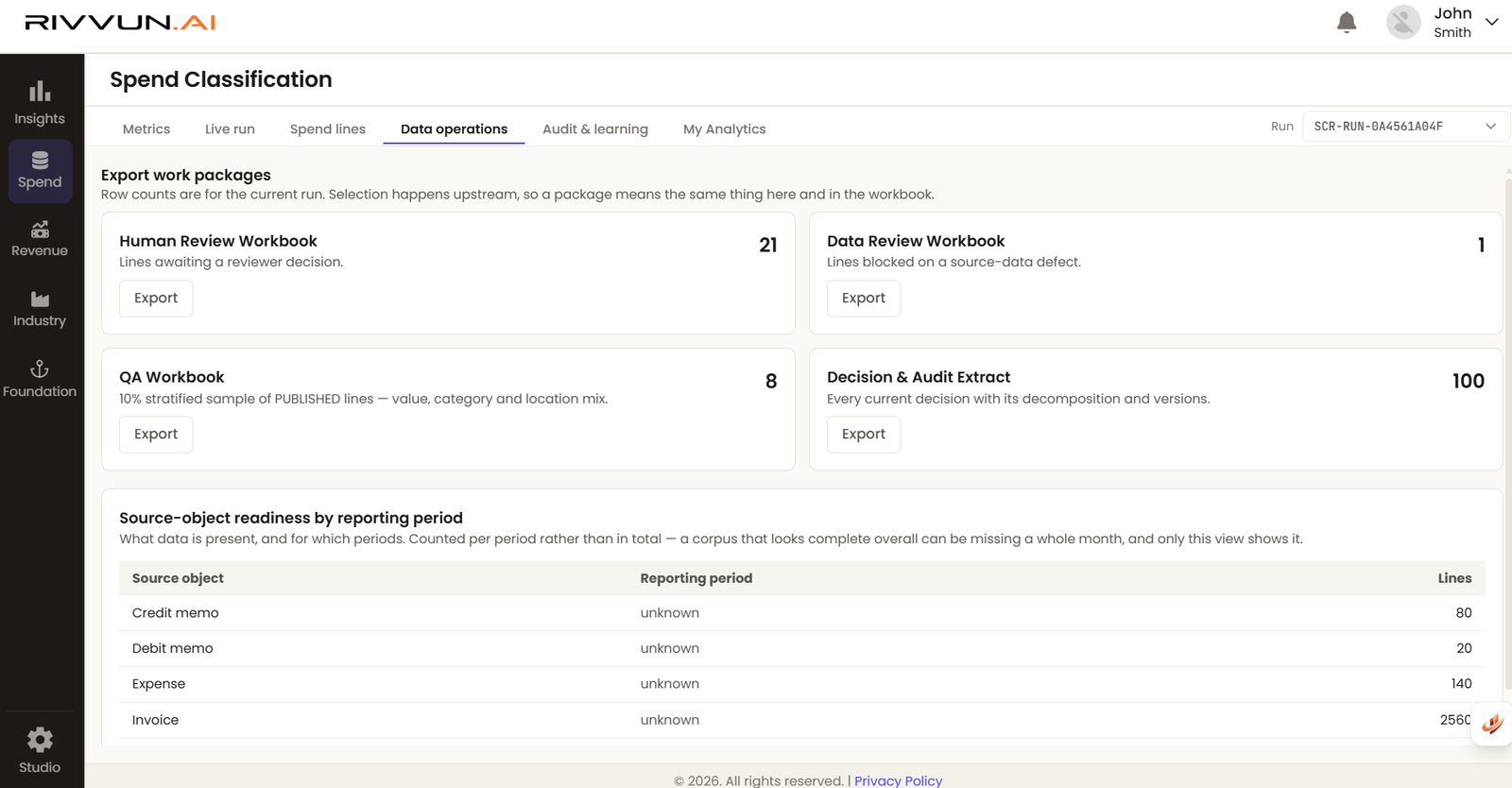
Yes. Supplier aliases are resolved, descriptions and units normalized, and available records linked. Where evidence is weak or conflicting, the line is routed to a parent category, human review or remediation — not forced into a leaf and not buried in “Other”.
What taxonomy does Rivvun classify to?
The customer’s taxonomy. Rivvun works to a standard scheme such as UNSPSC or to a bespoke category tree, and holds the taxonomy, category policy and depth rules as versioned configuration rather than hard-coded logic.
How is classification accuracy measured?
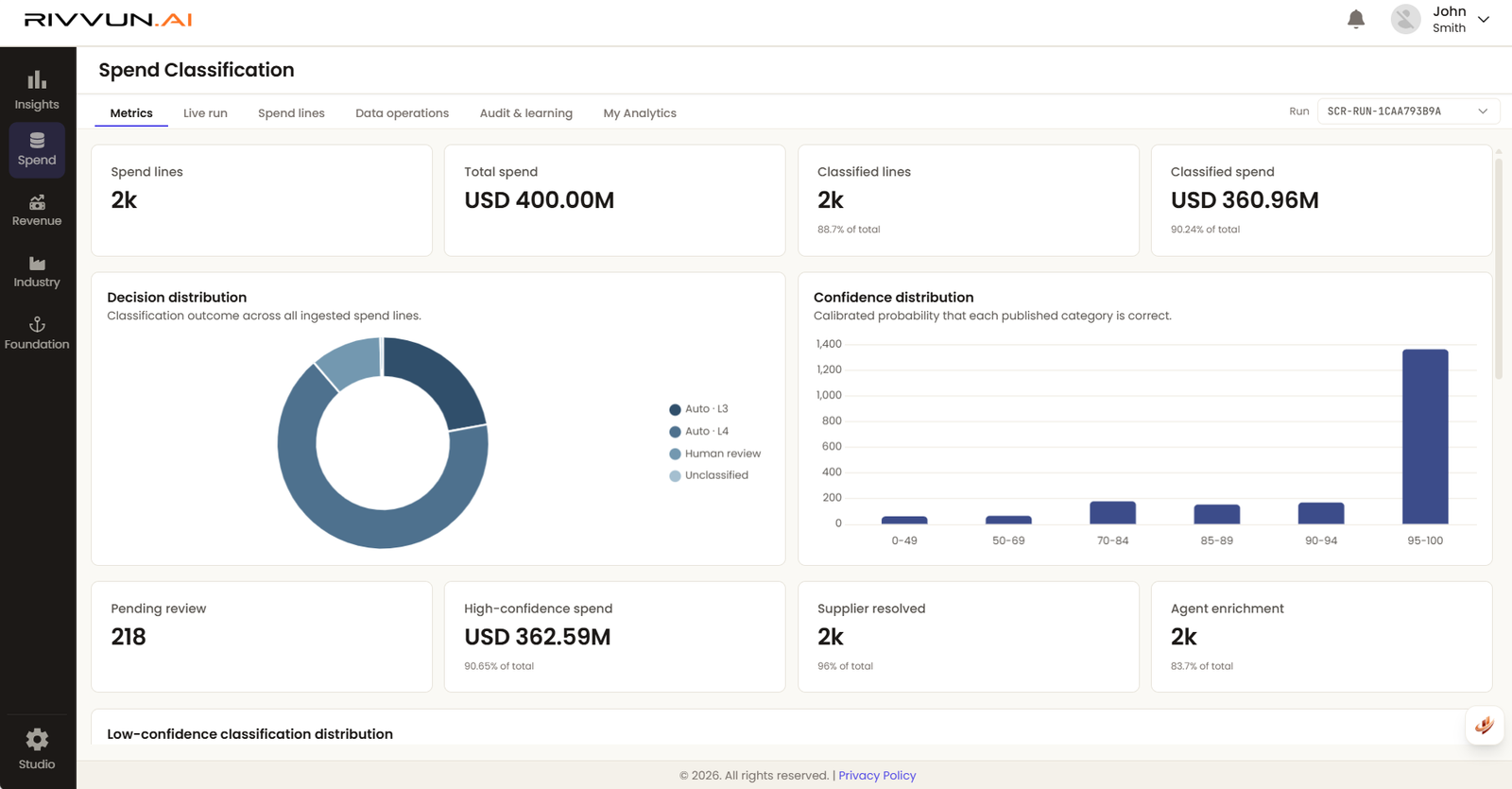
Coverage is the share of eligible spend classified at a defensible depth. Validated accuracy is golden-set precision by category and data tier. Review load, override rate, reproducibility across runs and evidence-linkage completeness are reported alongside — because a single accuracy percentage hides the categories that matter.
How does contract evidence improve classification?
Contract Steward supplies governing scope, catalog, SOW and commercial context. That evidence confirms or challenges each category candidate and gives downstream analysis the contract authority needed to tell a valid variance from an addressable one.
Does the classifier calculate procurement savings?
No — classification and savings are kept separate by design. Spend Steward, Rivvun’s agentic AI, first builds the trusted fact base, then uses the classified ledger with contract, supplier, price and transaction context to identify opportunities, open action cases and track outcomes. Classification metrics are never confused with savings claims.
How does Spend Steward learn without creating uncontrolled mappings?
Only approved reviewer decisions become reusable mappings. Each is versioned, scoped and time-bounded, and a future conflict can suspend it. A model suggestion on its own never becomes enterprise truth.
Does Rivvun replace a spend analytics tool or spend cube?
No — it makes them trustworthy. Your spend analytics tool keeps reporting and visualizing; Rivvun supplies the classified, evidence-linked line data every spend analysis view should stand on. The same ledger also feeds contract checks, invoice controls, leakage recovery and sourcing execution — so analysis turns into action.