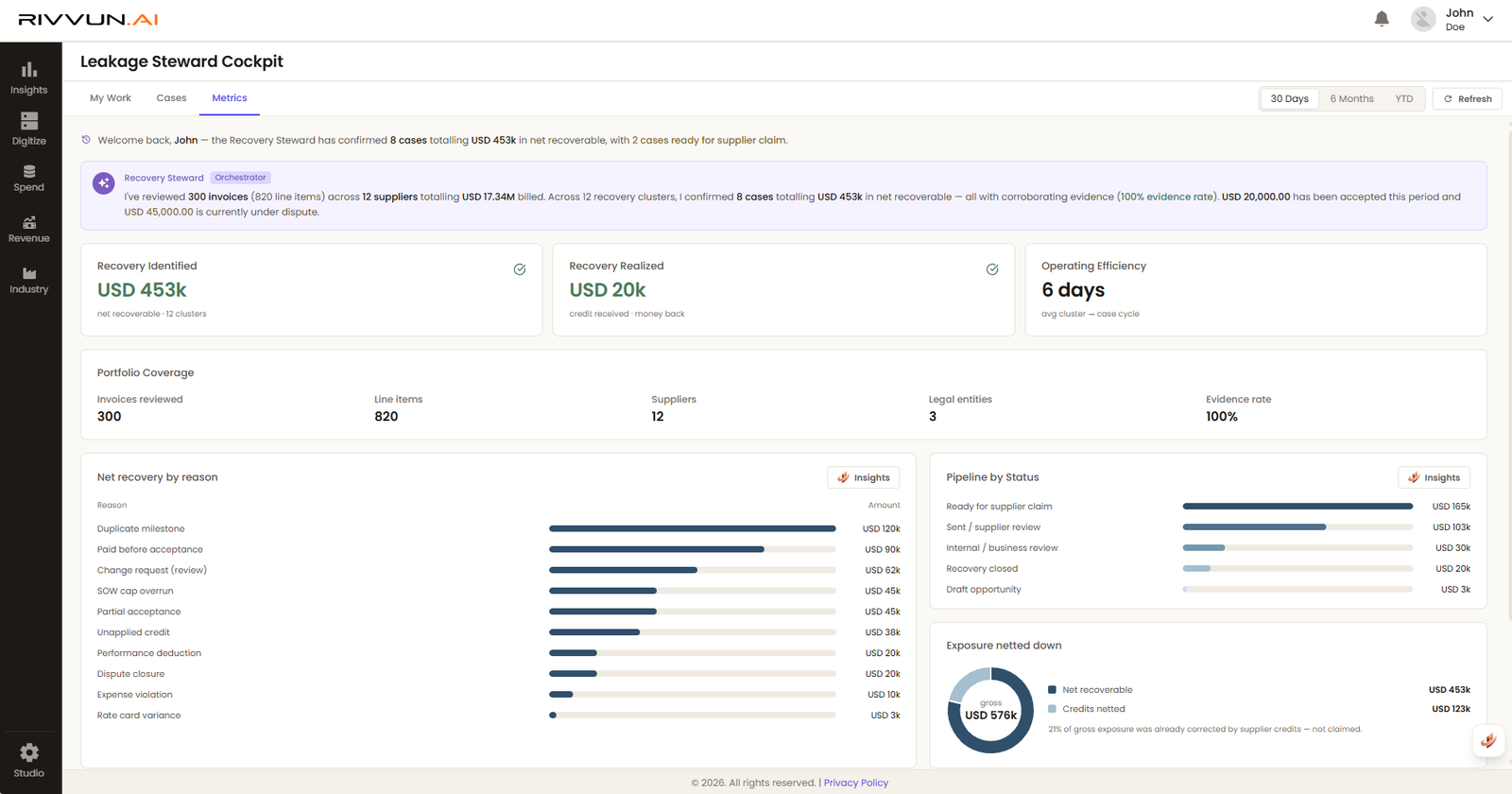
Rivvun is an agentic AI platform for procurement savings management, built for Fortune 1000 procurement and finance teams. Its AI agents — the Stewards — identify and prioritize new savings, enforce post-award contract compliance, prevent leakage, recover missed supplier cash and keep a finance-verified record of every saving that reaches the P&L. The result: procurement cost reduction you can prove, not just report.
A trusted, transaction-level spend foundation exposing price dispersion, supplier concentration and category opportunity.
Explore solution →Supplier consolidation, demand aggregation, price harmonization and payment-term opportunities across entities and regions.
Explore solution →Savings tracking from hypothesis to approved initiative, owner, baseline and finance-verified realization.
Explore solution →Negotiated rates, discounts, indexation, payment terms and service levels turned into transaction-level controls.
Explore solution →Material price, indexation, freight, quantity, UOM and supplier-term variance controlled across plants and regions.
Explore solution →Every line checked against what the supplier is actually allowed to bill — off-rate billing, invalid fees and duplicates stopped before payment.
Explore solution →Supplier rebates, credits and earned discounts calculated, claimed, reconciled and
banked.
Cash recovered from historical overpayments, missed credits and unclaimed supplier value.
Explore solution →Every solution reuses the same supplier, item, contract, PO, invoice, payment, rebate and operational evidence.
Resolves identities and relationships across systems into one governed evidence layer.
Establishes the governing commercial authority — which contract term applies to each transaction.
Records the financial outcome, from identified opportunity through to finance-accepted value.
Terms never reach the buying channel
Rates, discounts and tiers agreed but not loaded where buyers transact.
Earned value never claimed
Rebates, credits and entitlements sit in schedules and supplier statements.
Off-contract and fragmented buying
Approved suppliers used on the wrong channel, catalog or entity terms.
Execution variance across sites
Plants and regions pay different effective prices for the same thing.
Price drift and invalid charges
Duplicates, wrong quantities, UOM errors, freight and fee leakage.
Credits and deductions not taken
Open credits unapplied; allowed holdbacks and SLA deductions missed.
Nothing here gets replaced. Rivvun runs across these systems and picks up where each one stops.
| What you already have | Where it stops | What Rivvun does next |
|---|---|---|
| Sourcing & negotiation | At the award | Enforces the award through to payment |
| CLM & contract intelligence | At the clause | Turns the clause into a transaction-level check |
| Spend analytics | At the variance | Proves whether the variance is valid, recoverable and preventable |
| AP automation | At the PO match | Adds contract, rate card, rebate and credit context at line level |
| Recovery audit | At last year's data | Recovers and prevents continuously, not once a year |
| ERP & source-to-pay | At the transaction record | Governs value across systems and writes the action back |
Every system above tells you what happened. None of them decides what to do next.
Your number is somewhere in this range. A bounded value scan tells you where.
Spend analytics shows you the variance; savings-tracking software records what you claim. Rivvun does the work in between: it attaches the governing contract term and the transaction evidence to each variance, decides whether it is valid, recoverable and preventable, then tracks the outcome through to finance-accepted savings.
No. Rivvun runs across them, builds the connected evidence layer they lack, and writes governed actions back to the right system of record.
Yes. Start with read-only extracts. Rivvun resolves supplier, contract, PO, invoice and item relationships with confidence and lineage, and routes what it cannot resolve for review.
Identified, validated and realized value are tracked separately, and hard savings stay distinct from cost avoidance, working capital and productivity.
Each AI agent — the Leakage Steward, for example — autonomously monitors every PO and invoice line, decides which contract term applies, and executes routine actions such as clearing valid lines or preparing claims. Consequential actions — holding an invoice, filing a recovery claim — wait for human approval. Policy thresholds, evidence requirements, confidence scores and segregation of duties set what each agent may recommend, prepare or execute.
Start with a procurement savings scan on one bounded population. We return the opportunity, the evidence, the validated value and the controls that hold it.
Start a procurement savings scan →