Rivvun AI — System of Outcomes

Supplier Leakage Recovery

Continuous AP Recovery Audit to identify and recover the overpayment. Prevent the recurrence.

What this solution does
Supplier Leakage Recovery is Rivvun’s continuous recovery audit and cash recovery solution. Agents autonomously monitor historical and active spend for duplicate payments, overbilled rates, missed credits and unclaimed entitlements, decide which findings hold up as claims, and execute each case through to reconciled, finance-accepted cash.
Product experience

Find it. Prove it. Get it back

System of Outcomes
Detect → Recover → Prevent → Scale

Detection & Case Formation

From signal to structured case

What you get

  • Historical and active transactions scanned
  • Related invoices, credits and payments clustered
  • Cases ranked by value and confidence
  • Claim window and limitation period tracked
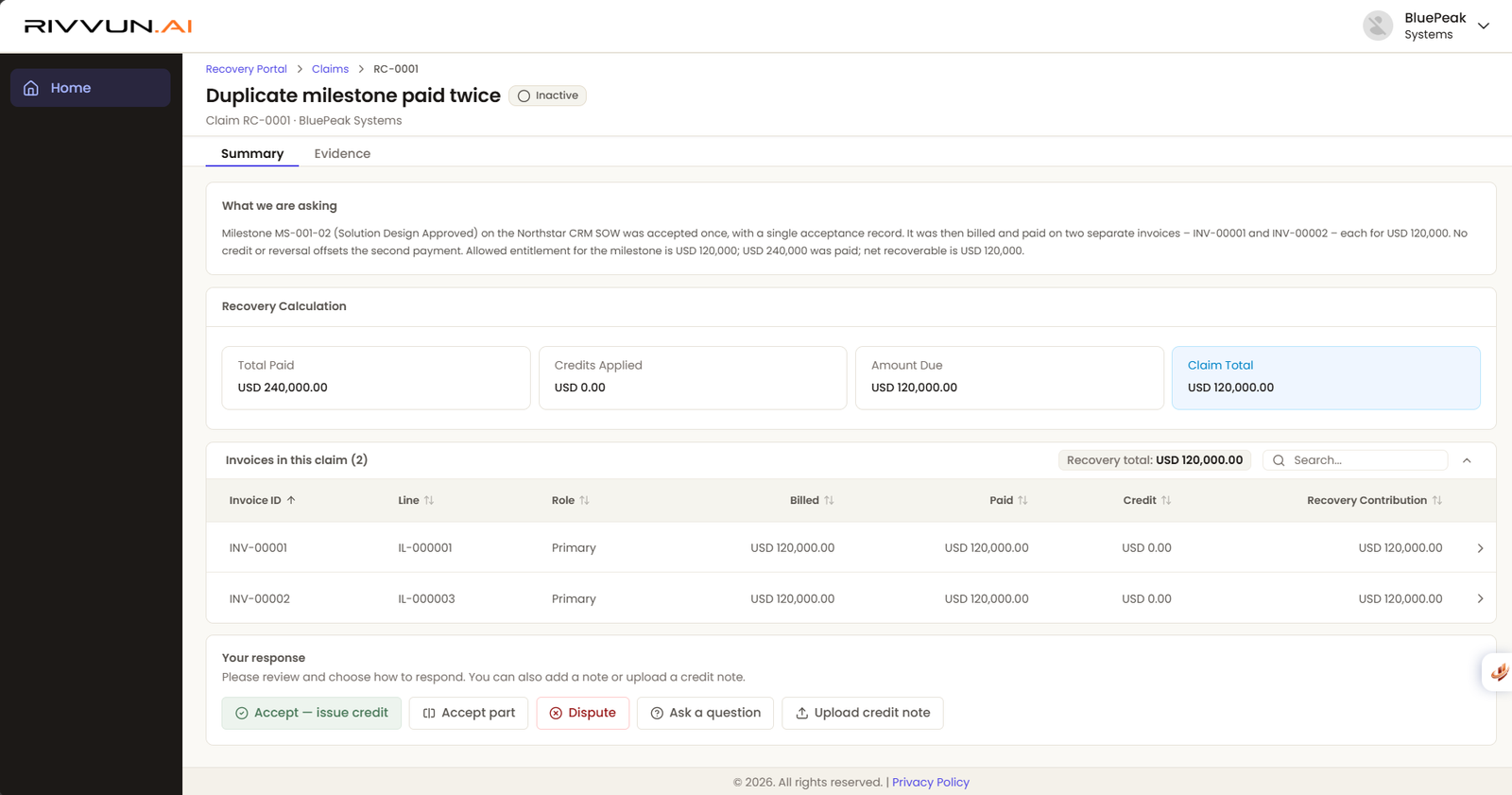
Recovery Portal · Supplier claim view Detection
Detection & Case Formation

Recovery Plays

The claims Rivvun runs

What you get

  • Duplicate payment recovery — double-paid and repeated invoices
  • Unapplied credits and missed deductions
  • Rate, discount and index overbilling
  • SLA, quality, warranty and rebate entitlements
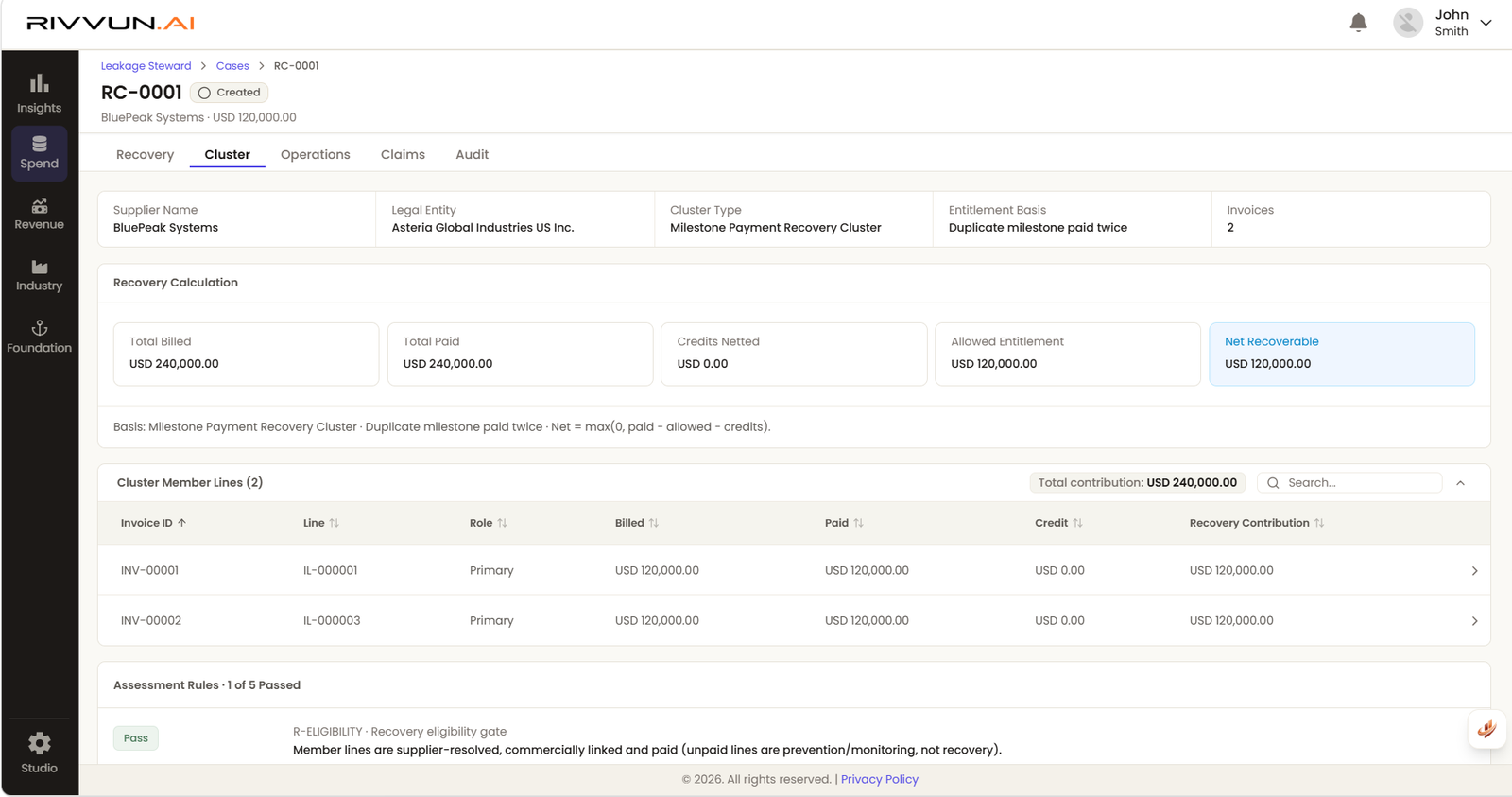
Recovery case · Cluster & calculation Plays
Recovery Plays

Evidence Pack & Claim

Supplier-ready in one step

What you get

  • Governing clause and calculation attached
  • Full transaction thread assembled automatically
  • Supplier-ready claim pack generated
  • Internal approval routed before it sends
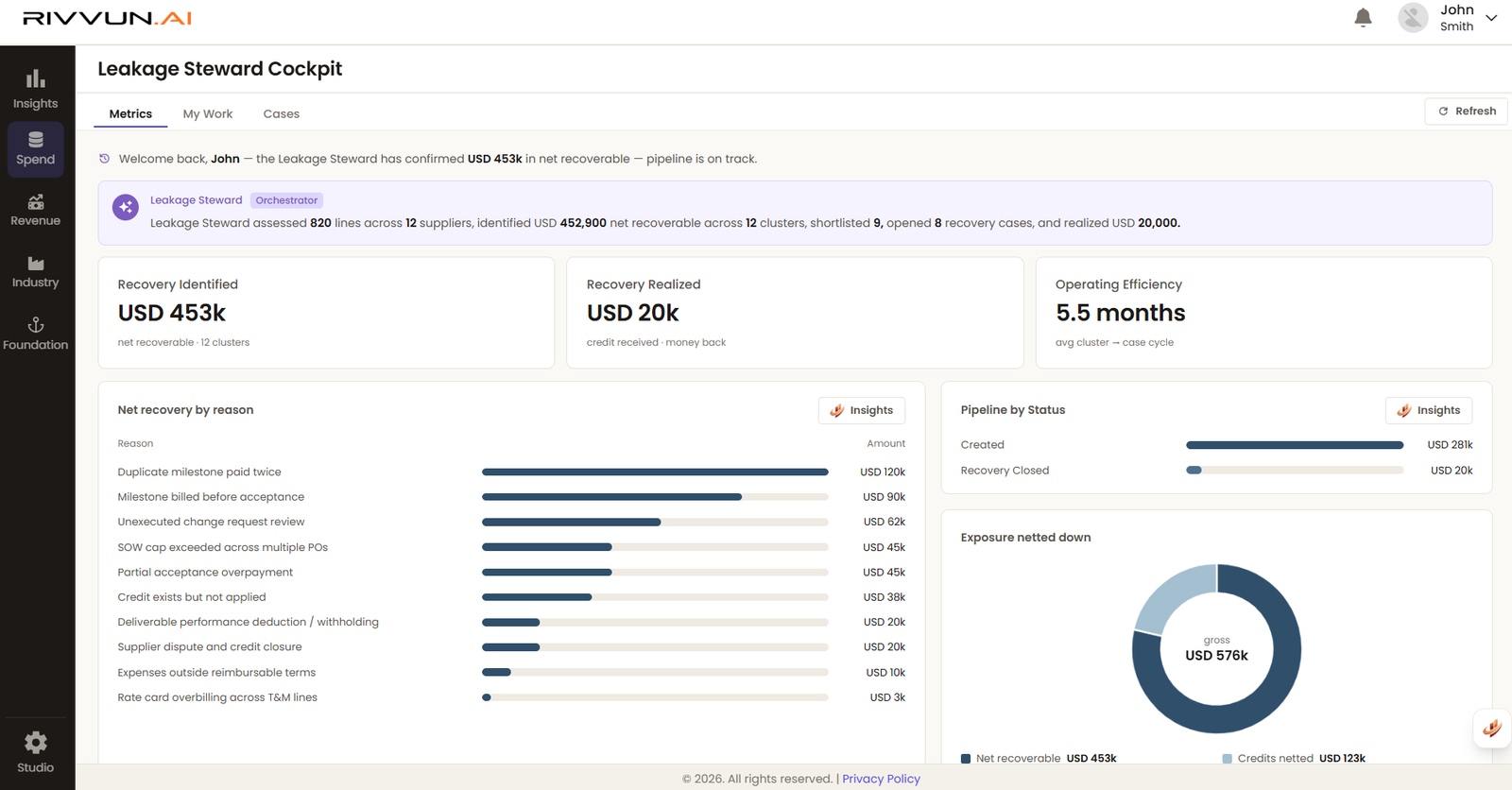
Leakage Steward · Recovery cockpit Evidence
Evidence Pack & Claim

Supplier Collaboration & Closure

Faster agreement, reconciled cash

What you get

  • Supplier workspace replaces the email chain
  • Responses and counter-evidence logged on the case
  • Credit, refund or offset reconciled to ledger
  • Root cause becomes a forward control
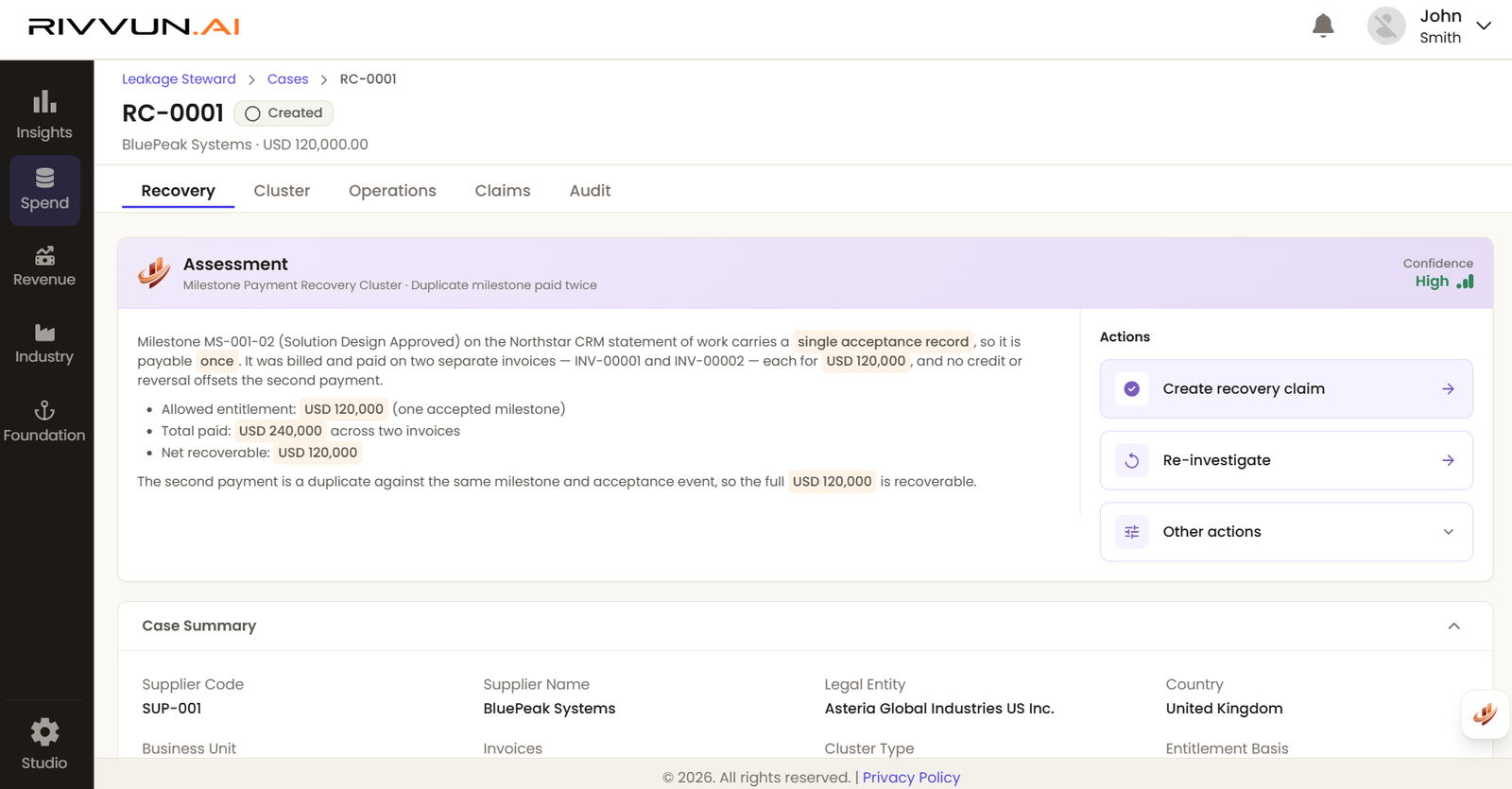
Recovery case · Assessment & claim Closure
Supplier Collaboration & Closure
Illustrative Model

What a recovery scan finds

$3.4B
Supplier payments
2
ERPs after an acquisition
4,800
Active vendors · 620 stores
2.1M
Invoices a year, shared-services AP

The challenge

A duplicate-payment review across 4.2M invoices at 1,000 invoices an analyst-day is 4,200 analyst-days — about 17 analyst-years — which is why this work only ever happens as a periodic contingency audit, years after the money left.

What agents find

Duplicate payments across two ERPs
$2.4M
Credit memos never applied
$1.9M
Deductions reversed, never re-taken
$1.4M
Statement credits open beyond terms
$0.7M
Overpayments on re-keyed invoices
$0.4M
Total identified
$6.8M

0.20% of payments in scope · 24 months, first-pass population

Value realization
$6.8M
Identified
$5.4M
Validated
$4.3M
Recoverable now
$1.1M
Preventable forward
Industry lens

Typical industry use cases

Energy — Utilities

Contractor and capex AP, mined for recovery

Capital programs run on unit-price and time-and-equipment contracts, mobilized fast and reconciled never. Duplicate tickets across work orders, mobilization billed per crew move, retainage released before completion.

What agentic AI changes

The agents mine months of contractor payments against the unit-price book and the work-order record — duplicates across systems, rates above schedule, equipment hours past demobilization. Recovered cash funds the program.

Energy — Oil & Gas (Upstream)

Recovery without waiting for the JV audit

Spend gets audited two years later, through the joint-venture audit cycle, when crews have demobilized and the leverage is gone. Duplicate field tickets, uncredited standby and rates above the schedule sit in paid history that nobody re-opens.

What agentic AI changes

The agents run continuous post-payment recovery across service invoices, tickets and contracts while the vendor relationship is still active. Working-interest partners see recoveries land in the JIB.

Common questions

What is supplier overpayment recovery?

Supplier overpayment recovery — often called profit recovery — identifies amounts paid beyond a supplier’s commercial entitlement (what the supplier was actually allowed to bill), validates them against contracts and transaction evidence, and recovers the value through a credit, refund, repayment or offset. Rivvun adds category playbooks, opportunity qualification, supplier-case management, finance reconciliation and recurrence prevention on top.

What is an AP recovery audit or post-payment audit?

An AP recovery audit — also called a post-payment audit — reviews paid invoices, payments, credits and supplier statements to find money already lost: duplicate payments, overbilled rates, missed credits. Rivvun runs this recovery audit continuously with an AI agent rather than as a one-off project, and a finding becomes a supplier claim only once the transaction population, governing terms, calculation and counter-evidence are confirmed.

How is continuous supplier recovery different from a contingency recovery audit?

A contingency recovery audit is a one-off, backward-looking sweep, typically paid as a share of recovered value — and it leaves root causes in place. Rivvun runs the recovery audit continuously: the same tests on every payment cycle, claims held to your evidence standards and case governance, and each confirmed root cause converted into a forward control that stops recurrence. Cadence, supplier-engagement model and commercial structure are defined in the agreed scope.

What data is needed for a supplier recovery scan?

Invoices, payments, credit memos, supplier statements, contracts and amendments, POs, receipts or service evidence, supplier master data, and the category-specific records needed to test the recovery hypothesis. Rivvun reconciles the eligible population and identifies missing evidence before any case is claimed.

How are missed supplier credits identified and recovered?

Rivvun reconciles supplier statements, credit notes, open items, invoices and payments to find credits issued but never applied, offsets duplicated or missed, and balances that do not reconcile. The validated credit is then driven through application, refund or offset and closed only when the supplier balance and ledger evidence agree.

How are category recovery playbooks used?

Each playbook defines the recovery hypothesis, qualifying transaction pattern, governing terms, required data, eligibility, exclusions, evidence threshold, claim window, calculation and permitted action. Only opportunities that clear the playbook’s decision gates advance into a recovery case.

How does Rivvun calculate net recoverable value?

Rivvun starts from the gross signal and subtracts existing or unapplied credits, reversals, later amendments, supplier counter-evidence, non-recoverable exclusions and other validated offsets. Incremental recovery cost is reported separately, so finance can distinguish gross recovery from net finance-accepted recovery.

How does finance validate recovered cash?

Finance validates the credit, refund, repayment or offset, confirms it was applied to the correct supplier balance and transaction population, and reconciles the resulting general-ledger treatment. Recovered cash stays separate from realized hard savings, cost avoidance and working-capital value.

How is recovered leakage prevented from recurring?

The validated root cause becomes a forward control in Invoice Assurance, Contract Compliance or Direct Spend Assurance. Rivvun then monitors the affected supplier, category and transaction pattern to confirm whether the exception recurs once the control is live.

Does Rivvun replace supplier statement reconciliation or duplicate-payment tools?

No. Those tools remain useful for specific matching and reconciliation tasks. Rivvun adds the contract, entitlement, category-playbook, counter-evidence, supplier-case and finance-closure layer required to turn a signal into defensible recovery and a reusable preventive control.

Start with one supplier group

Recover what was overpaid — and stop paying it twice.

Pick one supplier group, category or entity and the invoices, payments, credits, statements and contracts behind it. Rivvun applies the relevant recovery playbooks, returns the qualified net recoverable value with its evidence, and defines the claim path and the forward control that prevents recurrence.

Start a supplier recovery scan