Rivvun AI — System of Outcomes

Procurement Savings & Opportunity Management

One governed pipeline from identified opportunity to finance-accepted savings.

Originate · Qualify · Review · Publish · Realize
What this solution does

Savings & Opportunity Management is Rivvun's agentic AI procurement savings management solution. Rivvun's agents identify and qualify savings opportunities; a human approves every one before it enters the managed pipeline — agents create candidates; people approve opportunities — and value is tracked from identified through validated to finance-accepted, with no double counting.

Why savings pipelines break

An identified opportunity is not a realized saving.

Most savings pipelines live in spreadsheets and PMO tools, disconnected from the transactions beneath them. Numbers get double counted, value types get mixed, facts change silently — and finance stops believing the total.

A savings tracker records what teams claim. Rivvun's pipeline holds what the evidence supports — every opportunity traceable to cases, transactions and the governing contract, from first signal to finance acceptance.

Product experience

From agent finding to managed, finance-ready opportunity.

System of Outcomes
Detect → Recover → Prevent → Scale

Two Paths, One Funnel

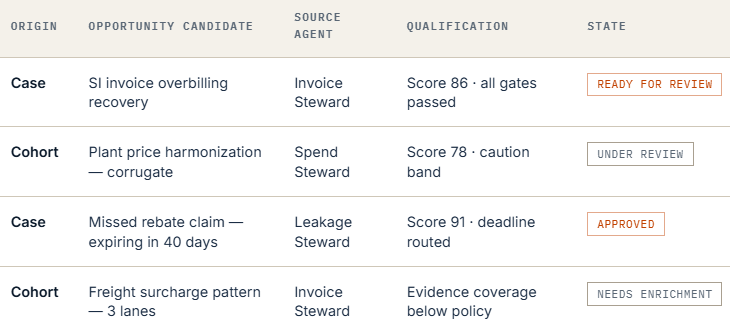
Single cases and category cohorts, one pipeline

Every opportunity enters the same way — however it was found.

  • A single material case — an overcharge, a claim, a renewal event — can qualify on its own.
  • A category playbook aggregates related cases into a cohort opportunity: harmonization, consolidation, tier capture.
  • Both paths pass the same gates, the same scoring, the same overlap checks and the same review.
  • Ideas that cannot be anchored to real transactions stay insights — they never become pipeline value.
Opportunity pipeline · Candidate funnel Interface preview
Two Paths, One Funnel

Qualification & Value Bridge

Hard gates, scores and defensible economics

Value that survives challenge — gross to net, every step shown.

  • Hard gates: case-backed value, transaction lineage, governing evidence, reproducible calculation, materiality, addressability and an open action window.
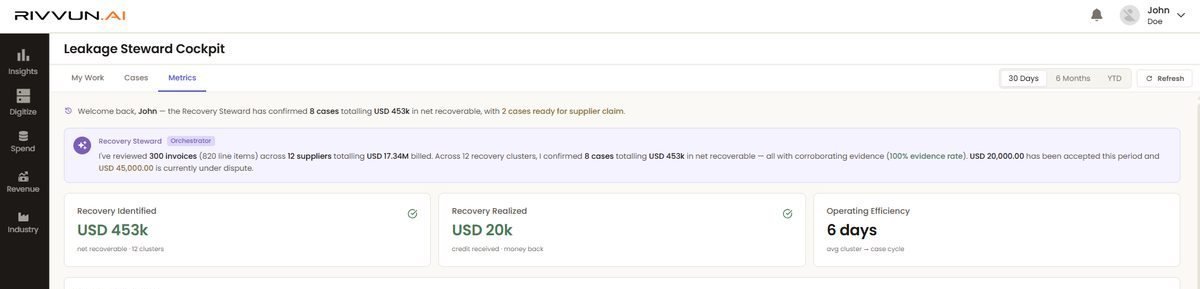
  • A transparent value bridge: gross signal → exclusions → offsets and credits → addressable → implementation cost → net potential → expected value.
  • Hard savings, recovered cash, prevented leakage, cost avoidance, working capital and productivity never mix.
  • Confidence, evidence coverage and success probability reported separately — never blended into one number.
Qualification service · Value bridge Reconciled
Qualification & Value Bridge

Review Workbench

The mandatory human gate

Approve, adjust, merge, split, defer or reject — with the evidence in front of you.

  • The full case file: value bridge, gate results, related cases, counter-evidence and drill-through to the transactions.
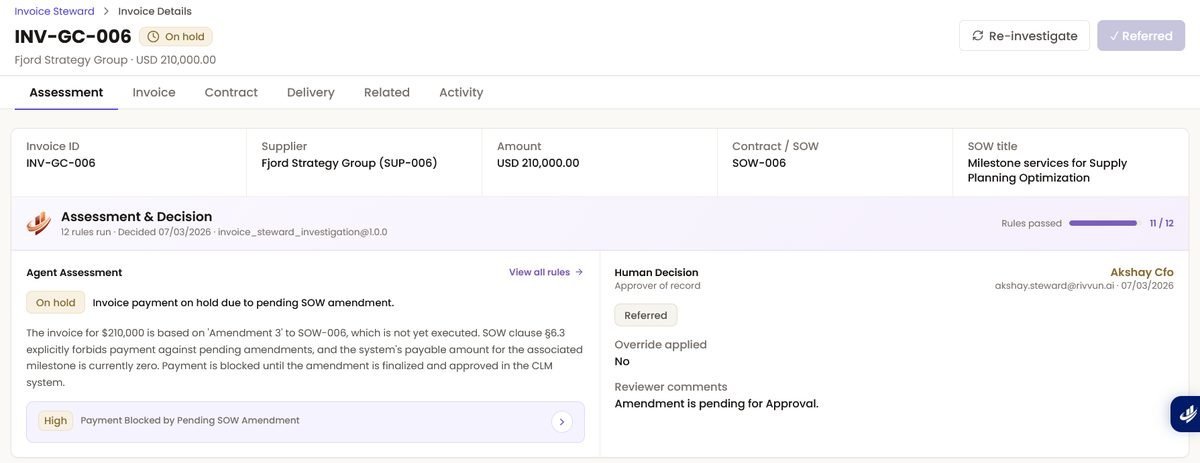
  • Reviewers adjust scope or value on a versioned bridge — but never edit source facts; corrections return to the agent.
  • Overlaps resolved before approval: duplicates merged, distinct owners, value types or time horizons split.
  • Every decision recorded with rationale, approver and conditions — immutable and auditable.
Review workbench · Candidate decision Human approved
Review Workbench

Publish, Track & Stay True

One pipeline, synced with finance

Approved opportunities stay honest after approval.

  • Published opportunities carry owner, action, deadline and verification path into portfolio management.
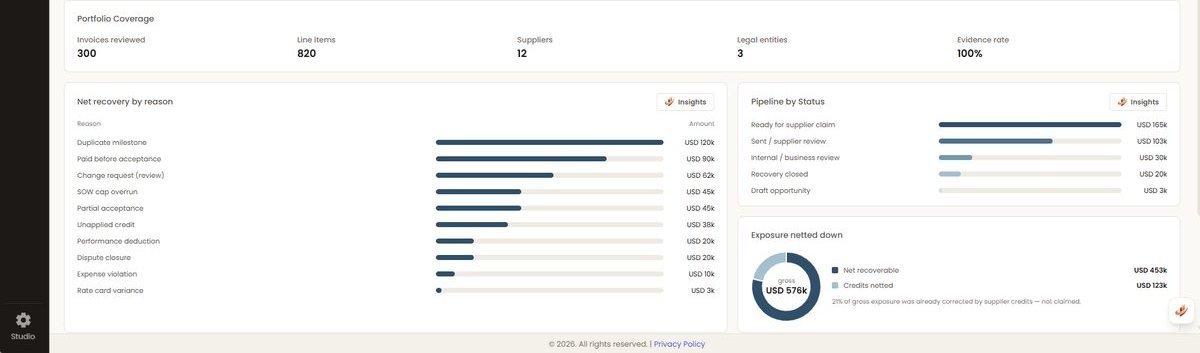
  • Identified, validated and realized value tracked as separate states — expected value is never reported as savings.
  • A material fact change — a credit, an amendment, a resolved dispute — marks the opportunity stale and triggers requalification.
  • Finance drills the same lineage procurement sees: opportunity → cases → transactions → governing contract.
Opportunity portfolio · Value states Finance in sync
Publish, Track & Stay True
Outcome

What procurement and finance gain

One pipeline, two audiences: procurement runs it, finance believes it.

Procurement
  • One pipeline, not nine spreadsheetsEvery agent's findings enter the same funnel under the same rules — nothing tracked on the side.
  • Opportunities that stay freshStale candidates requalify when facts change; claim and renewal windows are ranked by days remaining.
  • No double countingOne economic issue, one canonical opportunity, one owner — merges and splits are explicit, recorded decisions.
  • Review effort where it mattersScores route strong candidates fast; weak ones go back for enrichment, not into the pipeline.
Finance
  • Every number tracesOpportunity to cases to transactions to the governing contract — snapshotted at the moment of decision.
  • Value types never mixedHard savings, recovery, avoidance, working capital and productivity reported separately, always.
  • Expected is not realizedPipeline value, expected value and finance-accepted value remain distinct states — no forecast in the savings total.
  • Decisions that stand in auditImmutable review records with policy versions, rationale, approvers and conditions.

Common questions

What is Procurement Savings & Opportunity Management?

It is Rivvun's agentic AI solution for governing the savings pipeline. Every opportunity Rivvun's agents identify — an invoice overcharge, a rebate claim, a harmonization play — enters one qualification, human-review and tracking pipeline, so procurement and finance work from a single number that traces to cases, transactions and contracts.

How are opportunities identified?

Two paths, one funnel. A single material case — a high-value overcharge, a discrete recovery claim, a renewal event — can qualify on its own. A category playbook can also aggregate many related cases into one cohort opportunity, such as plant price harmonization or volume-tier capture. Both paths pass the same gates, scoring, overlap checks and review.

Why is human review mandatory?

Agents create candidates; people approve opportunities. Automated gates and scores control quality and routing, but no candidate enters the managed pipeline until a configured reviewer approves it — and a score never auto-approves. Approval makes an opportunity eligible for management and tracking; it is not approval to execute, and not finance acceptance of value.

How does Rivvun prevent double counting?

Candidates are fingerprinted and matched by transaction population, supplier, category, period, baseline and root cause before approval. One economic issue gets one canonical opportunity, one owner and one baseline; duplicates are merged, distinct action paths are split, and hard savings, recovered cash, avoidance, working capital and productivity are never mixed.

What happens when the underlying data changes?

The opportunity goes stale instead of quietly rotting. A material change — a new credit, a contract amendment, revised entity resolution, a policy update — marks the candidate or published opportunity stale and triggers requalification. The agent reruns the case, a new version is created, and the prior review decision stays immutable and auditable.

How is this different from a savings tracker or PMO tool?

A tracker records what teams claim. Rivvun's pipeline holds what the evidence supports: every opportunity links to cases, every case to a real transaction population and the governing contract, and the calculation is reproducible and versioned. Forecast-only ideas that cannot be anchored to transactions stay analytical insights — they never enter pipeline value.

How do procurement and finance stay on the same number?

Because there is only one number. Identified, validated and realized value are tracked as separate states on the same object, expected value is never reported as savings, and finance can drill from any total to the cases, transactions and contract terms beneath it — with the decision snapshot preserved from the moment of approval.

When does value count as realized?

Only when the downstream value process confirms it with evidence — a subsequent invoice at the corrected price, a received credit, a banked claim — and finance accepts it. Qualification produces pipeline value and expected value; realized value is never created at the agent level, and prevention, recovery and future savings are reported separately.

Start with your current pipeline

Bring your savings pipeline — leave with one you can defend.

Give us your current opportunity list and the data behind one category. Rivvun returns the qualified pipeline: what survives the gates, what merges, what has gone stale — and the value bridge finance can sign.

Start a savings pipeline review