What is direct spend management?
Direct spend management covers the materials, components, packaging, freight, production services and related supplier economics that flow directly into the goods a company produces and into COGS. Rivvun complements sourcing, ERP and source-to-pay systems with a value-assurance and execution layer that applies category playbooks, qualifies savings opportunities, manages action and verifies the financial outcome.
What is Direct Spend Assurance?
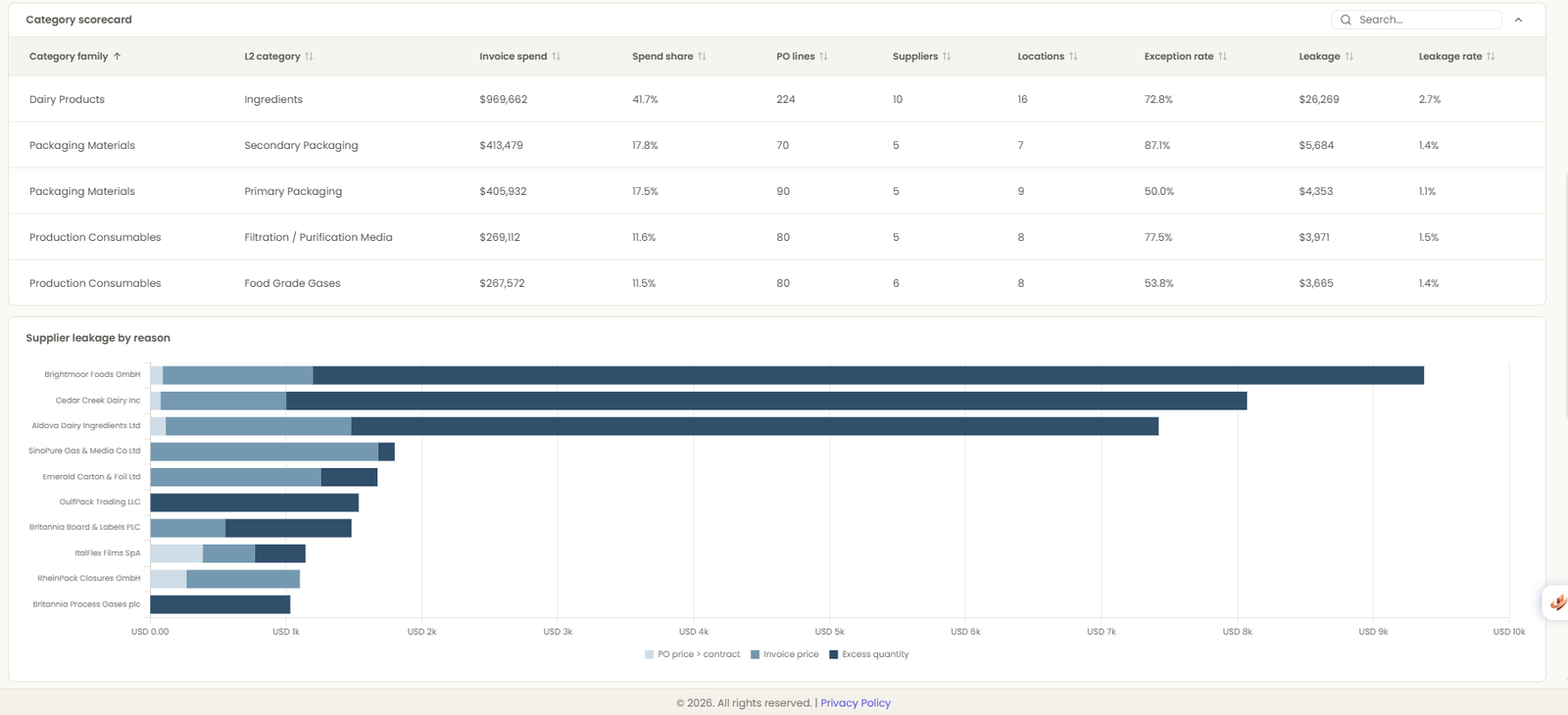
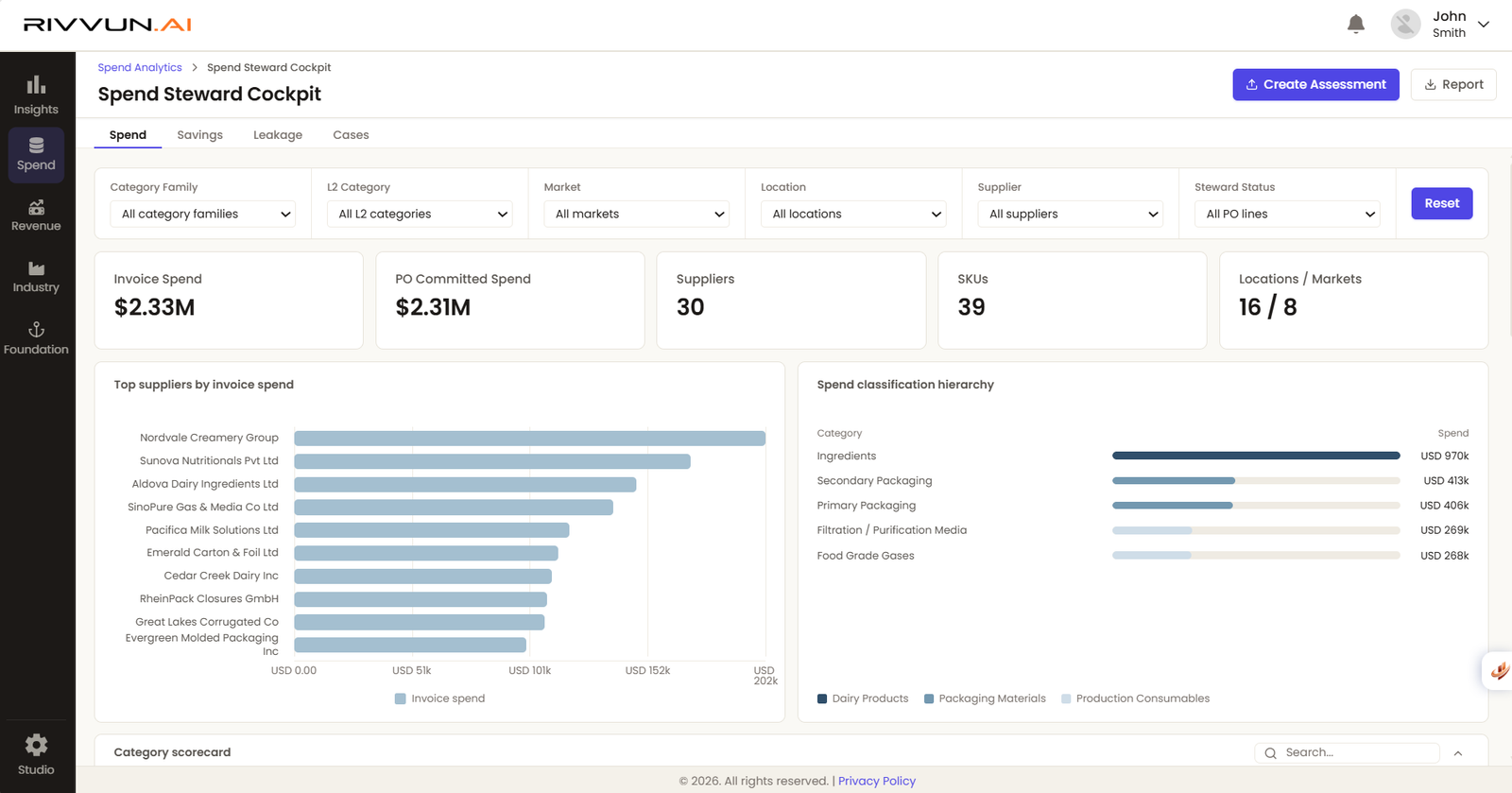
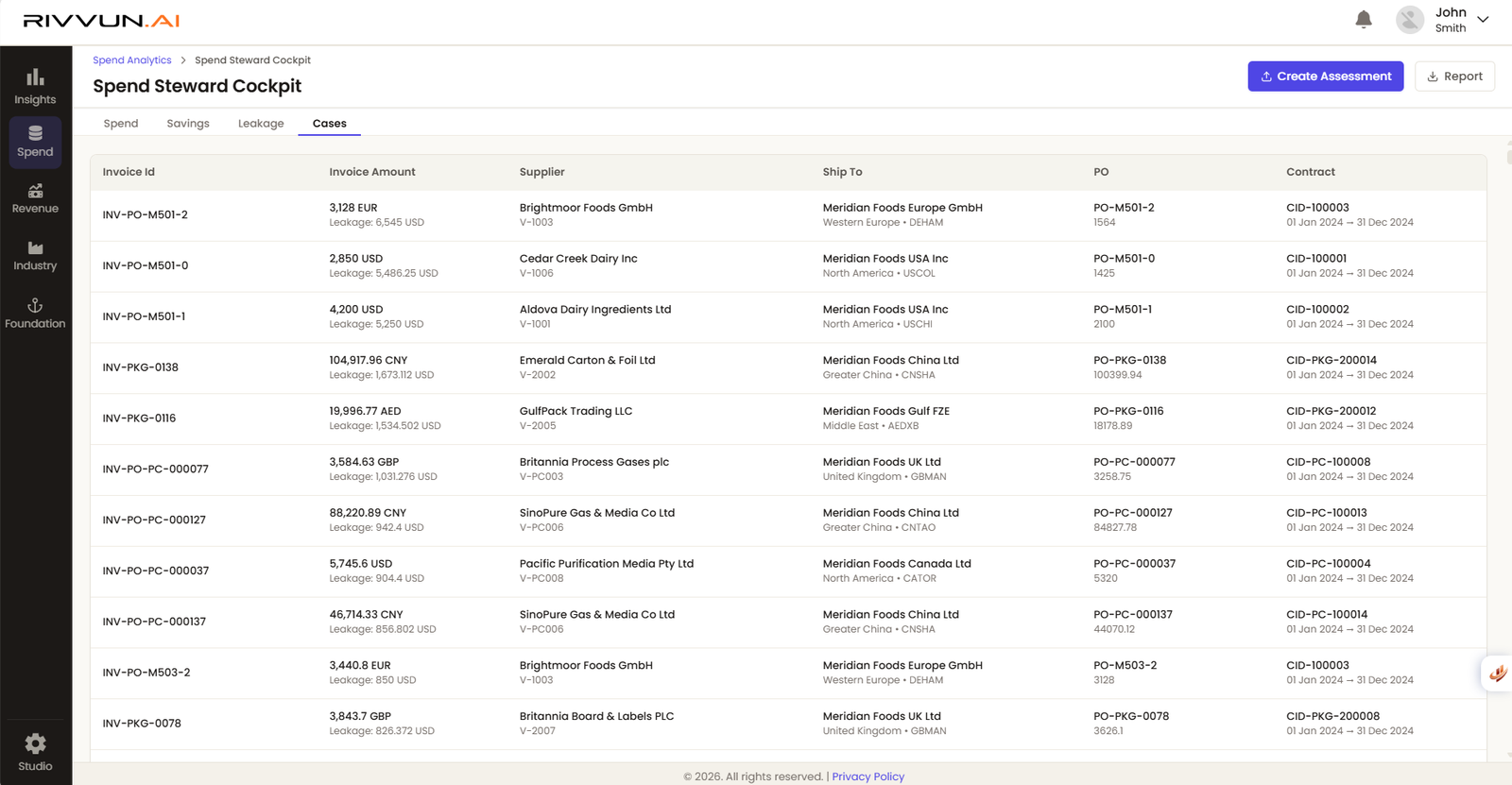
Direct Spend Assurance is Rivvun’s agentic AI solution for finding, qualifying, executing and verifying direct material cost savings. It connects category economics, supplier contracts, price files, item and material data, POs, receipts, freight, quality, invoices and credits so procurement can move from a savings signal to an owned action and finance-accepted result.
How is Direct Spend Assurance different from a PPV dashboard?
A purchase price variance (PPV) dashboard shows movement against a standard, prior price or budget. Rivvun’s AI agents go further: they normalize the contract, index, specification, UOM, plant and landed-cost basis; determine whether the variance is addressable; apply the relevant category savings playbook; prepare the opportunity case; track execution; and verify the result in subsequent transactions. Your category managers and finance keep the decisions.
How does Rivvun identify direct material cost savings?
Rivvun first creates a comparable spend population by resolving supplier, item, specification, UOM, plant, period and landed-cost differences. It then separates market or index movement from contract noncompliance and structural cost, applies category-specific savings levers, quantifies gross and addressable value, tests feasibility and risk, and ranks the opportunities for action.
What is total landed cost optimization?
Total landed cost optimization evaluates the complete economics of a material or movement — not only the unit price. The analysis can include contracted price, indexation, freight, fuel, accessorials, duties, taxes, fees, UOM and pack conversion, quality, yield and operational constraints. Rivvun uses that normalized basis to identify opportunities and verify whether the implemented change reduced the cost actually paid.
How does commodity and index-based price compliance work?
Rivvun recalculates the expected price using the governing benchmark, formula, lag, FX basis, floor, cap, reset date, volume tier and effective period. It compares that expected amount with the price file, PO and invoice, separates valid market movement from incorrect application, and routes the variance into correction, negotiation or recovery as appropriate.
How does plant price harmonization create savings?
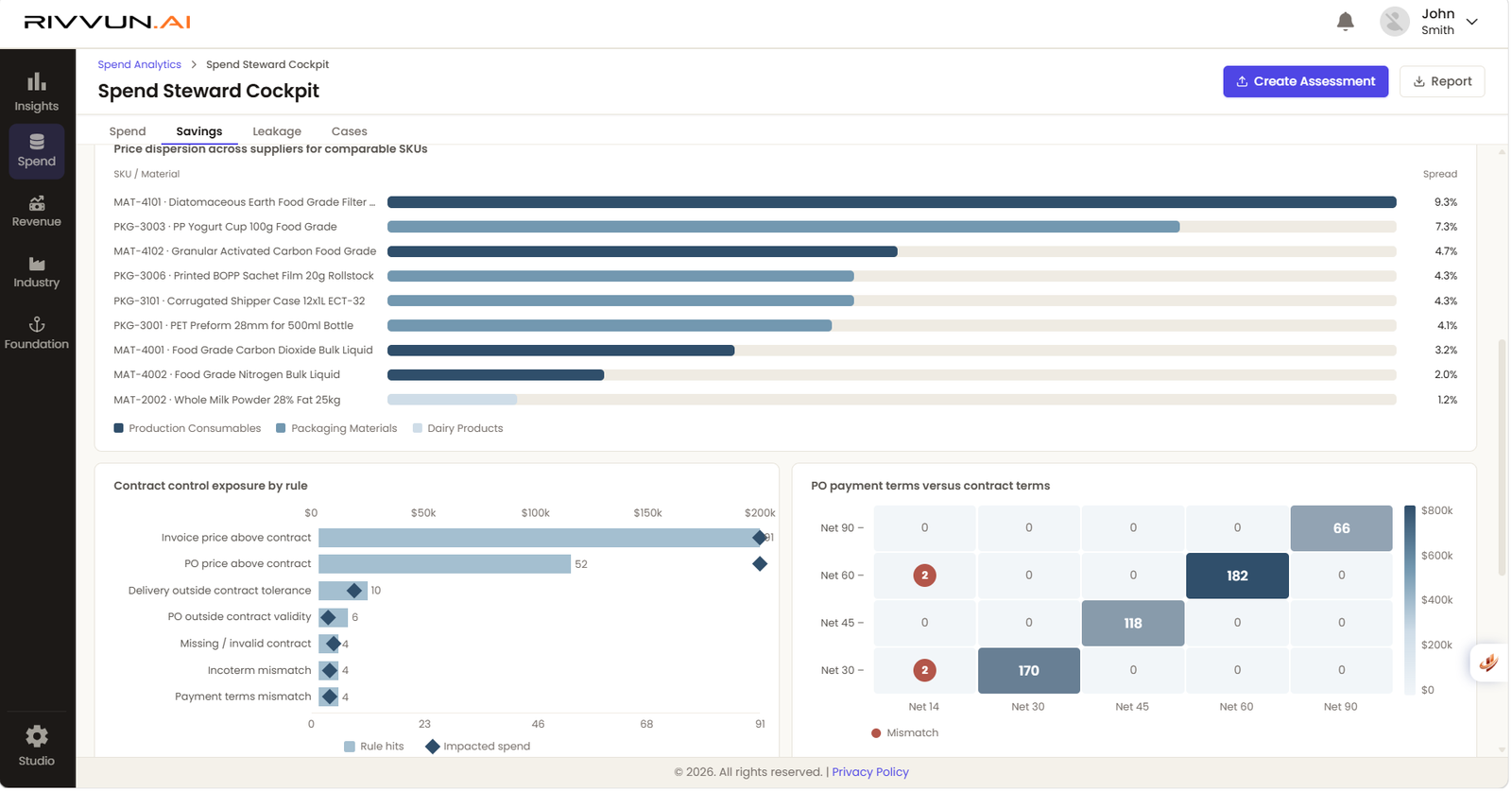
Rivvun normalizes material identity, specification, UOM, freight basis, volume, contract term and plant context before comparing prices. Legitimate local differences remain visible; unexplained dispersion becomes a qualified harmonization opportunity that can be executed through supplier negotiation, price-file correction, volume reallocation, specification standardization or a sourcing event.
Which category-specific savings playbooks can Rivvun support?
Playbooks are configured to the customer’s category strategy and evidence. Examples include corrugated packaging, where the levers may include board grade, dimensions, print, order pattern, freight and supplier allocation; ingredients and commodities, covering index, grade, yield, source mix, tiers and freight; MRO spare parts, covering part identity, alternates, markup and supplier rationalization; and inbound freight, covering lane, mode, fuel, accessorials, allocation and compliance.
Can Rivvun work with messy item masters and inconsistent units of measure?
Yes. Rivvun resolves supplier parents and aliases, item and material identities, specifications, pack sizes, units, plants and alternates with lineage and confidence. Unresolved or conflicting records are routed for review rather than forced into a comparable cohort or savings calculation.
How do procurement and finance verify direct-material savings?
Rivvun keeps the value lifecycle explicit: identified, qualified, approved, committed, implemented and finance accepted. Each case carries the normalized baseline, comparable transaction population, evidence, action, owner and implementation record. Finance acceptance is based on subsequent PO, receipt, invoice, credit, payment or production evidence and the customer’s approved value methodology.
What is a Direct Spend Savings Scan?
A Direct Spend Savings Scan is a bounded assessment of one category, material family, supplier group or plant cluster. Rivvun applies the relevant playbooks, normalizes the spend population, returns qualified opportunities and decision-ready cases, advances selected actions and establishes the evidence and acceptance method required for scaling.
Does Rivvun replace ERP, source-to-pay or spend analytics?
No. ERP and source-to-pay remain the systems of record and process. Spend analytics continues to provide broad visibility. Rivvun works across those systems as the category-led value-assurance and execution layer that connects commercial evidence to opportunities, governed actions and finance-verified outcomes.